What 'Cheapest' Really Means for a Cross-Country Move
When people ask for the cheapest way to move across Canada, they usually picture a single magic answer. In reality, the lowest-cost option depends entirely on your shipment size, distance, flexibility and how much physical work you are willing to do yourself. The cheapest move for a single university student with two rooms of furniture is completely different from the cheapest move for a family of five relocating a four-bedroom home.

The key insight is that "cheap" is never just about the sticker price. The true cost of a move includes your time, fuel, accommodation en route, insurance risk, potential damage, and the value of the days you spend driving instead of working. A bargain rental truck that destroys a weekend and risks your back can easily cost more in real terms than a smartly chosen long distance moving company that handles everything for a transparent flat rate.
This guide walks through every realistic budget option for 2026, with honest CAD numbers, so you can match the right method to your situation. For the full pricing picture behind professional moves, pair this article with our detailed breakdown of long distance moving costs in Canada.
The honest truth: For very small loads, DIY or a container is usually cheapest. For mid-to-large households travelling long distances, a consolidated or off-peak full-service move from a reputable carrier often wins on total real cost once you account for time, fuel and risk.
Comparing Your Moving Options by Cost

Before diving into each method, here is a high-level comparison of what each approach typically costs in 2026 for a two-bedroom household moving roughly 3,500 km (for example Ottawa to Calgary). Use this as your starting map.
2026 Cost Comparison — 2-Bedroom, ~3,500 km:
- DIY rental truck (one-way): $3,500 – $6,500 all-in
- Moving container / pod: $3,800 – $6,000
- Consolidated / shared-load shipping: $4,500 – $7,000
- Hybrid (you pack, pros ship): $5,000 – $7,500
- Full-service professional move: $6,000 – $9,500
Notice that the gaps are narrower than most people expect. A DIY truck looks cheapest on paper, but once you add one-way drop fees, fuel for a heavy truck, insurance, hotels and meals across four days of driving, the real number climbs quickly toward the container and consolidated options — without the convenience or protection.
💡 Pro Tip: Always calculate the all-in cost, not the advertised base rate. Rental trucks in particular advertise low daily rates that exclude per-kilometre charges, fuel, and one-way surcharges that can triple the final bill on a cross-country trip.
Containers and consolidated shipping have become genuinely competitive in recent years. We explore the container route in depth in our guide to moving containers and pods across Canada, which often delivers the best balance of price and convenience for flexible movers.
DIY Rental Trucks: The True Numbers
The classic budget option is renting a one-way moving truck and driving it yourself. It can be the cheapest route for small, light loads on shorter distances — but the economics shift fast on a true cross-country haul.
What Goes Into the Real DIY Cost
- Truck rental (one-way): $1,500 – $3,500 depending on size and route
- Fuel: A 26-ft truck gets roughly 18–25 L/100 km. Over 3,500 km that is 600–875 litres — easily $1,000–$1,400 in diesel.
- Insurance and damage waiver: $200 – $600
- Hotels en route: 3–4 nights at $130–$200 each
- Meals on the road: $200 – $400
- Equipment (dolly, pads, straps): $100 – $250
Add it up and a "cheap" DIY move often lands between $3,500 and $6,500 all-in — plus four exhausting days of driving a large vehicle through mountain passes and prairie crosswinds. For heavy loads, the fuel penalty alone can make DIY more expensive than a consolidated professional shipment.
⚠️ The hidden DIY risks: You are personally liable for any accident, your belongings carry no professional insurance, and back injuries from loading heavy furniture are common. Factor these risks into your decision, not just the dollar figure.
DIY makes the most sense for students, light loads, and shorter routes. For anything larger or longer, compare it honestly against a cross-country moving company quote — you may find the convenience and protection cost far less than expected once your own time and fuel are counted. Our comparison of DIY vs professional long distance moving breaks this trade-off down case by case.
Moving Containers and Pods
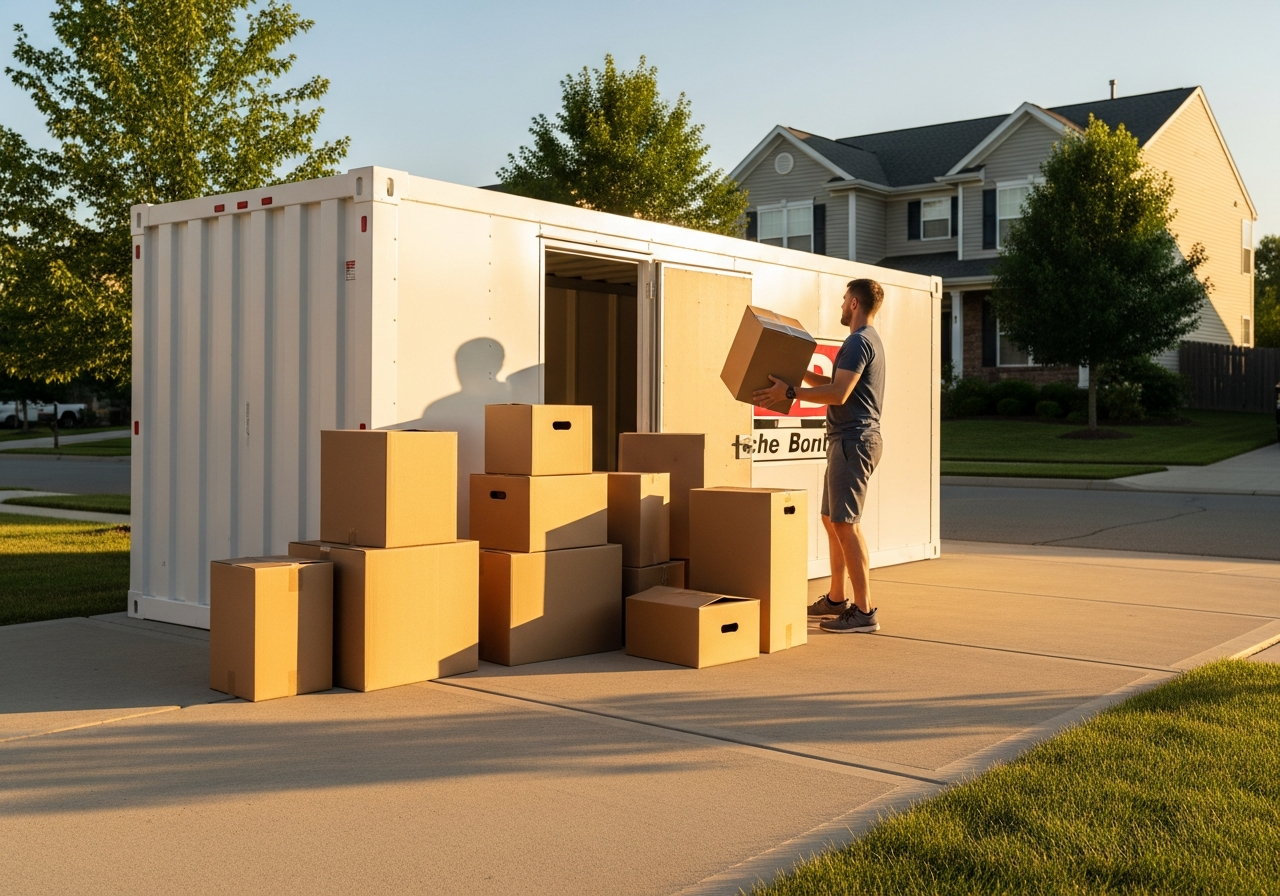
Portable moving containers have transformed the budget moving landscape. The company drops a container at your home, you load it at your own pace over several days, and they transport it across the country to your new address.
Why Containers Are Often the Sweet Spot
- No driving: A professional driver handles the long-haul transport, eliminating fuel, hotels and the risk of driving a strange truck.
- Flexible loading: You load over days, not in a single frantic session.
- Built-in storage: Many providers let the container double as storage if your dates do not line up.
- Predictable pricing: Container moves are usually quoted as a flat rate per container plus distance.
For a two-bedroom home moving 3,500 km, expect roughly $3,800–$6,000 in 2026. The main trade-off is that you still do all the loading and unloading labour yourself, and you must have space and permission to place the container at both ends.
💡 Pro Tip: Pack the container tightly and high, using furniture pads between items. Loose loads shift over thousands of kilometres and cause far more damage than a snug, well-secured load.
Containers shine for organized, flexible movers with mid-sized loads. If you want the convenience of professional transport without the full-service price, this is frequently the cheapest practical option. Many long distance moving services now offer container solutions alongside traditional van-line moves, so it is worth asking a single provider to quote both.
Consolidated and Shared-Load Shipping
Consolidated shipping — sometimes called shared-load or LTL (less-than-truckload) moving — is one of the best-kept secrets of affordable cross-country relocation. Your shipment shares trailer space with other households heading the same direction, and you pay only for the space and weight you use.
How It Works
Instead of dedicating an entire truck to your move, the carrier combines several shipments travelling the same corridor. This dramatically lowers the per-shipment transport cost because the fixed expense of driving the truck is split across multiple customers. The trade-off is a wider delivery window — typically 7–14 days — because the truck makes multiple pickups and drop-offs.
Best suited for:
- Smaller to mid-sized households (studio to two-bedroom)
- Movers with flexible delivery dates
- Routes along major corridors (Ontario–BC, Quebec–Alberta, etc.)
For a one- to two-bedroom load travelling cross-country, consolidated shipping with a reputable interprovincial moving company can come in well below a dedicated full-service move while still giving you professional handling and insurance. It bridges the gap between DIY economy and full-service convenience.
⚠️ Confirm the delivery window: Consolidated moves trade speed for savings. If you need belongings on a specific date, this method may not suit you. Always get the delivery window in writing.
Because your goods are handled and re-handled more often in a consolidated move, upgrading your valuation coverage is wise. Verify any carrier you consider against the Canadian Association of Movers directory before booking.
Hybrid Moves: Pack Yourself, Ship With Pros
The hybrid approach captures most of the savings of DIY while keeping the safety and convenience of professional transport. You handle the packing and sometimes the loading; the movers handle the long-haul driving, the heavy lifting on the truck, and the logistics.
Where You Save
- Packing labour: Doing your own boxes saves $1,000–$2,800 on a typical home.
- Materials: Sourcing free or used boxes instead of buying premium kits.
- Selective service: Paying movers only for the genuinely heavy or fragile items.
This model works beautifully for organized people who have time before the move but want professionals to manage the actual transport across thousands of kilometres. You keep control of your possessions and timeline while offloading the riskiest part — driving a loaded truck across the country.
💡 Pro Tip: Even in a hybrid move, leave dishes, electronics, mirrors and art to the professionals or pack them with proper materials. These are the items most likely to break in transit, and a cracked TV erases your packing savings instantly.
A flexible nationwide moving company will happily build a custom hybrid package, letting you choose exactly which services to buy. This à la carte approach is one of the smartest ways to control cost without taking on the full burden and liability of a DIY move. If you want to weigh full-service against self-pack in detail, our guide to DIY versus professional moving lays out every scenario.
Timing Your Move to Save the Most
Timing is one of the most powerful and most overlooked cost levers. The same move can cost 20–30% more in July than in November, regardless of which method you choose.
The Cheapest Windows
- Off-season: October through April carries the lowest rates as trucks have spare capacity.
- Mid-month: Avoid the last three and first three days of any month, when real estate closings spike demand.
- Mid-week: Tuesday through Thursday moves cost less than weekend moves.
The cheapest possible slot is a mid-week, mid-month day in the dead of winter. The trade-off is weather: winter routes across the Prairies and through the Rockies can face storms and delays. Check road conditions on tools like DriveBC and 511 Alberta when planning a cold-season move.
Flexibility = savings: The more flexible your dates, the more leverage you have. Telling a mover "I can go any time in the next three weeks" unlocks the best rates as they fit you into open slots on their schedule.
If you can decouple your move from peak season, you capture the single biggest discount available. Combine off-peak timing with a consolidated or container method and you have the cheapest realistic way to move a mid-sized household across Canada.
Cutting Weight: The Biggest Lever You Control
No matter which method you choose, the amount you move directly drives the cost. Weight determines fuel for DIY trucks, space for containers, and the line-haul charge for professional moves. Aggressive decluttering is the most reliable way to cut your bill.
What to Shed Before a Long Distance Move
- Furniture you would replace anyway: Cheap particle-board pieces often cost more to ship than to rebuy.
- Books and paper: Extremely heavy per cubic foot; digitize or donate.
- Appliances: Shipping a fridge across the country rarely makes financial sense.
- Garage and basement clutter: Tools, paint, old sports gear and seasonal items.
💡 Pro Tip: Hold a moving sale or list items online 6–8 weeks before your move. Money you earn selling bulky, low-value items often exceeds what it would cost to ship them — a true double saving.
For container and consolidated moves, less volume and weight can even drop you into a smaller, cheaper tier. For full-service moves, every hundred pounds you remove comes straight off the line-haul charge. The discipline of moving less is the closest thing to a guaranteed discount in the entire process.
Pair decluttering with our full cost guide to model exactly how much each kilogram saved translates into dollars on your specific route. A focused weekend of decluttering routinely saves families several hundred dollars on a cross-country move.
When Cheap Becomes Expensive
The cheapest-looking option can quietly become the most expensive one. Recognizing these traps protects both your wallet and your peace of mind.
⚠️ Common false economies:
- Skipping insurance: Basic liability pays just $0.60/lb. One broken TV or scratched table can wipe out everything you saved.
- Unvetted bargain movers: Suspiciously cheap quotes are a classic scam setup with hostage-load tactics and surprise fees.
- Underestimating DIY fatigue: Driving 3,500 km exhausted increases accident risk dramatically.
- Cheap packing materials: Flimsy boxes collapse and damage contents over thousands of kilometres.
A lowball quote that is hundreds of dollars below every competitor is almost always a warning sign rather than a deal. Reputable operators have similar underlying costs — fuel, labour and trucks are not free for anyone. When one bid is dramatically lower, the savings usually come from cut corners or hidden fees that surface later.
The genuinely cheapest move is the one that arrives complete, undamaged and on budget. Spending slightly more for professional long distance movers with proper insurance and a binding estimate frequently costs less in the end than a "bargain" that turns into a claim, a delay, or a dispute.
Key Takeaway: Optimize for lowest total real cost — including time, risk and potential damage — not just the lowest advertised price. The two are often very different numbers.
Building Your Lowest-Cost Move Plan
Bringing it all together, here is a practical framework for designing the cheapest move that still protects your belongings and sanity.
- Right-size the method. Small load and short route: DIY or container. Mid-sized load: container or consolidated. Large home or coast-to-coast: off-peak full-service or consolidated.
- Declutter ruthlessly. Cut weight and volume before getting quotes so estimates reflect your lighter load.
- Pick an off-peak, mid-month, mid-week date. Stack timing savings on top of method savings.
- Get three written quotes. Normalize them and watch for lowball red flags.
- Choose a hybrid service mix. Pack what you safely can; let pros handle fragile and heavy items.
- Buy appropriate insurance. Do not let a cheap move become an expensive claim.
For most families relocating a mid-sized household across Canada in 2026, the winning combination is an off-peak consolidated or container move paired with self-packing and aggressive decluttering. This blend routinely beats both naive DIY and premium full-service on total real cost.
When you are ready to compare real numbers for your situation, request a free moving quote and ask the provider to price both a consolidated and a container option so you can see the cheapest path for your exact load and route. A transparent cross-Canada movers partner will gladly model multiple scenarios so you can choose with full information.
Frequently Asked Questions
What is genuinely the cheapest way to move across Canada?
For small, light loads, a one-way DIY rental truck or a moving container is usually cheapest. For mid-sized households, consolidated (shared-load) shipping during off-peak season is typically the lowest total-cost option once time, fuel and risk are factored in.
Are moving containers cheaper than full-service movers?
Often yes, for mid-sized loads, because you provide the loading and unloading labour while professionals handle transport. Expect roughly $3,800–$6,000 for a two-bedroom load travelling 3,500 km, versus $6,000–$9,500 for full service.
Is it cheaper to rent a truck and drive myself?
Only for small loads on shorter routes. Once you add one-way drop fees, fuel for a heavy truck, insurance, hotels and meals over several days, DIY often costs nearly as much as a container or consolidated move — without the convenience or professional insurance.
How much can off-peak timing save me?
Moving in the off-season (October–April), mid-month and mid-week can save 20–30% compared with a summer month-end date, regardless of which moving method you choose.
Does decluttering really lower the cost?
Significantly. Because every method charges by weight or volume, removing furniture, books and appliances you do not need directly reduces your bill — and selling those items can offset move costs further.
Is consolidated shipping safe for my belongings?
Yes, when you use an accredited carrier. Your goods are handled more often than in a dedicated move, so upgrading your valuation coverage is wise, but reputable consolidated movers pad, secure and track shipments professionally.
Why are some quotes so much cheaper than others?
Extremely low quotes often hide excluded fees, omit insurance, or signal a broker or scam operation. Always normalize quotes, confirm inclusions in writing, and verify the company before choosing the cheapest bid.