What Changes When Your Move Leaves Ottawa
Long-distance movers from Ottawa should be compared using the same route, inventory, pickup requirements, delivery expectations, and service scope. Before booking, confirm the company responsible for transportation, request written costs and terms, ask how transit updates work, and understand whether delivery dates are fixed or estimated. A road trip’s driving time is not the same as a household shipment’s delivery window.
A move across Ottawa can often be planned around a single loading and delivery day. A long-distance move from Ottawa adds more decisions: the route, shipment size, pickup and delivery dates, storage needs, travel arrangements, and the way the carrier will communicate while your belongings are in transit. Planning these details early makes it easier to compare long-distance movers and spot gaps in a quote.
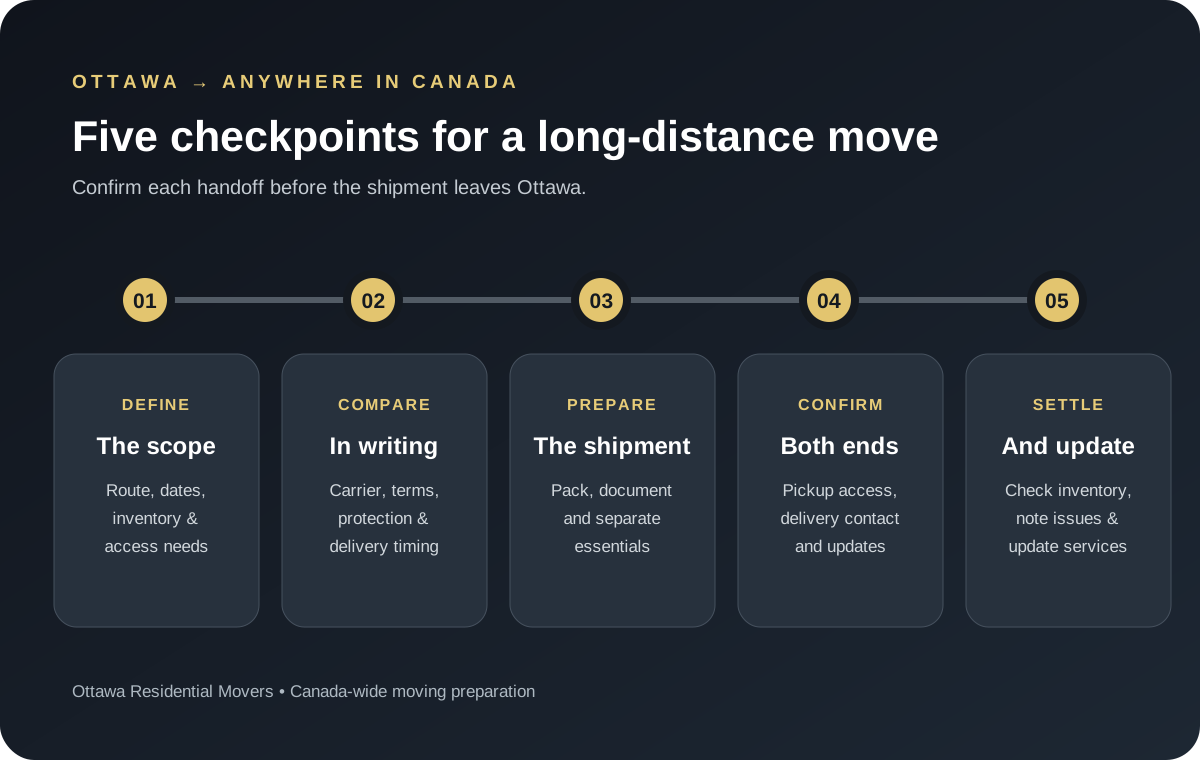
Start by defining the move clearly. Record the origin and destination addresses, the earliest date you can load, the date you must be out, and the date you need your belongings delivered. If your new home is not ready, ask about storage, access fees, and how the shipment will be protected during the gap. Keep your travel plan separate from the shipment schedule so you know what you will need before the truck arrives.
Routes from Ottawa can range from nearby Ontario and Quebec destinations to moves across the Prairies, Atlantic Canada, or British Columbia. A move to Montréal or Toronto has different access and timing considerations from a coast-to-coast relocation. The key is not to assume that a carrier’s generic “long-distance” service answers the questions for your particular route. Ask for the planned pickup process, proposed transit plan, delivery commitments, and what could change them. Do not use a consumer driving estimate as a promised moving-truck delivery time.
If your destination is within the Ottawa area, compare the local moving services in Ottawa instead; the route and estimate should reflect a local move rather than a cross-country shipment.
For local planning, see the site’s Ottawa neighbourhood moving guide and the Ottawa–Gatineau relocation guide. For packing methods, use the companion Ottawa packing-services guide.

Build a Route-Specific Moving Timeline
Six to eight weeks before pickup: create a household inventory, request written estimates, and confirm whether the provider is the carrier or a broker arranging service through another company. Share the full inventory, special-care items, stairs, elevators, parking limits, and any storage requirement. Ask about cancellation terms and the deposit before paying.
Four to six weeks before pickup: choose a mover after comparing the written scope, not only the price. Confirm the named company responsible for pickup and delivery, the date range or confirmed dates, how shipment changes are handled, and the contact person. If you are moving for work, school, or a lease, coordinate those fixed dates before accepting a flexible delivery window.
Two to three weeks before pickup: reduce the shipment by donating, selling, or responsibly disposing of items you do not want at the destination. Reconfirm the inventory and ask how the mover wants high-value, unusually heavy, or fragile pieces documented. Arrange elevator and loading access at both addresses, and verify truck parking rules with property managers or local authorities where necessary.
One week before pickup: complete most packing, keep essentials separate, and confirm the pickup plan in writing. Record the mover’s office number and the after-hours contact method. Keep travel documents, medication, work devices, valuables, and several days of clothing with you. If a delivery appointment depends on access to a new home, make sure someone can receive the shipment.
After delivery: compare the delivered goods with the inventory, note visible concerns promptly, and follow the mover’s written process for reporting loss or damage. Save the quote, inventory, receipts, emails, and delivery paperwork together until the move is fully settled.
Compare Long-Distance Moving Quotes Fairly
A useful long-distance estimate should describe what is being moved and what service is being purchased. The federal Office of Consumer Affairs recommends getting estimates from multiple reputable movers, making sure the mover has seen the goods, and getting costs and terms in writing. Its moving advice for Canadian consumers also highlights questions about broker arrangements, insurance, and written commitments.
Ask every company to quote the same origin, destination, inventory, packing scope, and delivery requirements. Check whether the written quote identifies the company performing transportation, the services included, how pickup and delivery timing are described, what is excluded, what payment is due and when, and which circumstances could change the cost. If an estimate uses a weight- or volume-based method, ask how the final shipment quantity is documented and how you receive the measurement.
Clarify whether the mover is a carrier or a broker. If a broker is involved, ask which company will physically collect and deliver the goods and who is responsible for claims and communication from start to finish. A low quote is not comparable if it omits packing, stairs, shuttle service, storage, long carries, or other services that another quote includes.
Ask about valuation and insurance in plain language. What protection is included? Is additional protection available? Are there exclusions, deductibles, declared-value requirements, or claim deadlines? Do not assume your home policy, the moving company’s carrier liability, and optional coverage are interchangeable. Contact your insurer and read the mover’s documentation before the shipment leaves.
Prestige Moving’s website describes long-distance moving from Ottawa to destinations across Canada. If you are considering the company, review its published long-distance moving services from Ottawa and confirm route availability, the company or carrier performing each part of the move, the written price, delivery window, and protection terms in your own estimate. The public service page does not replace those move-specific details.
Prepare Your Inventory and Long-Haul Packing
A precise inventory helps the mover plan truck space, labour, materials, and special handling. Group items by room and describe large pieces specifically: “three-seat sofa” is more useful than “living-room furniture.” Include outdoor equipment, storage rooms, basement items, tools, appliances, and anything stored off-site. Tell the estimator about narrow access, steep stairs, elevator bookings, and the distance between the truck and front door at both locations.
Long-distance packing should limit movement inside cartons and protect edges from repeated handling. Use strong cartons in sizes suited to their contents, wrap individual fragile pieces, cushion empty spaces, and avoid overfilling. Keep heavy items in manageable boxes. Photograph valuable or delicate belongings before packing, and discuss items requiring custom crates, special orientation, or manufacturer-specific preparation.
Separate items that should not travel in the shipment. These commonly include important documents, medication, jewellery, cash, keys, and devices or work materials you need during the trip. Ask the mover for its prohibited-items list before packing aerosols, fuel, propane, solvents, paint, perishable food, plants, or batteries. Rules may differ depending on the item and transportation arrangement; get a clear answer from the carrier.
If you want a professional packing crew, ask whether the company can pack the full home, selected rooms, or fragile items only. Confirm the materials, labels, disassembly, unpacking, and debris removal included in the price. The related packing-services guide for Ottawa households includes a room-by-room method you can use whether you pack yourself or hire packers.
At pickup, review the inventory and condition notes with the crew lead. Keep a copy of the final paperwork and photograph any item condition that is specifically recorded. At delivery, compare the shipment against the inventory before signing documents that say everything arrived without exceptions; ask the mover how to note a discrepancy correctly.
Coordinate Pickup, Transit, and Delivery
Pickup and delivery are separate operational events. Confirm the loading address, contact person, access window, elevator booking, truck parking, and the list of items that must not be loaded. At the destination, verify that the building or property will be ready to receive a truck and that someone can provide access during the agreed time.
Ask how transit updates work. You should know whom to contact for a schedule change, what information the company will provide while goods are moving, and how delivery appointments are confirmed. If dates are estimates rather than guaranteed commitments, make sure you understand the delivery window before booking accommodation, taking leave from work, or arranging temporary furniture.
Plan for a gap between pickup and delivery. Pack an essentials suitcase, basic cookware, linens, a few days of clothing, chargers, children’s supplies, and anything needed for work or health. If you need storage, find out whether it is at the origin, in transit, or near the destination; ask how access, billing, inventory, and redelivery are handled.
For interprovincial relocations, create a destination checklist as well as a moving checklist. The Government of Canada notes that a change of address is not automatically shared across federal departments. Use the official Government of Canada address-change guide to identify which services you need to update, then check the province or territory’s procedures for items such as health coverage, driver licensing, and vehicle registration.
Keep a digital folder for the quote, inventory, receipts, contact details, insurance documents, and delivery notes. This makes it easier to answer questions while travelling and gives you one place to record updates if the move schedule changes.

Ottawa-to-Canada Moving Scenarios
Ottawa to Toronto or the Greater Toronto Area: ask about building elevator windows, downtown loading rules, parking, and whether the delivery date in the written plan is firm or estimated. Share the new address and access details early, especially for high-rise buildings or locations with limited truck space. See the site’s Ottawa-to-Toronto moving guide for a route-specific checklist.
Ottawa to Montréal or another Quebec destination: confirm the destination municipality, property access, building rules, and any paperwork or timing that may apply to your household. If crossing the Ottawa River within the National Capital Region, use our Ottawa–Gatineau guide; a nearby cross-river move is not the same planning problem as a long-haul trip to another province.
Ottawa to Western or Atlantic Canada: plan around a wider separation between pickup and delivery and do not assume you can replace essentials quickly at the destination. Confirm how the shipment is identified, who provides progress updates, whether goods are moved directly or consolidated, and whether the delivery date is a fixed commitment or a range. Ask how weather disruptions and access changes are communicated.
Moving for work or school: coordinate the move with your start date, temporary accommodation, and any employer reimbursement rules. Keep receipts and ask the employer what documentation is required before booking. For possible tax treatment, consult the Canada Revenue Agency’s moving expenses information; eligibility depends on the applicable rules and your circumstances.
Whichever route you choose, written details make the move easier to manage. The site’s complete long-distance moving guide from Ottawa provides additional route and service-planning information.
Frequently Asked Questions About Long-Distance Moves
How far ahead should I book long-distance movers from Ottawa?
Begin comparing movers as soon as your destination and likely dates are known. Several weeks of lead time gives you room to compare written estimates, confirm access at both homes, and arrange travel or storage. Peak dates and complex shipments may need earlier planning.
How can I compare long-distance moving quotes?
Give each company the same inventory, route, dates, access details, packing request, and storage needs. Compare the written scope, who performs the move, how the shipment quantity is measured, what protection applies, payment terms, exclusions, and delivery commitments.
Should I use a moving company or a broker?
Either arrangement requires clear accountability. Find out which company will collect, transport, and deliver your goods, who handles customer service and claims, and whether subcontractors will be involved. Get the names and responsibilities in writing before agreeing.
What should I keep with me during a cross-country move?
Keep medication, identity and travel documents, jewellery, cash, keys, chargers, work essentials, important records, and several days of clothing with you. Ask the carrier about prohibited goods and keep any time-sensitive essentials out of storage.
How do I prepare for a delay between pickup and delivery?
Ask whether the delivery date is fixed or estimated and what updates the mover provides. Arrange temporary accommodation if needed, carry essential supplies, and confirm the storage process and fees before pickup if the destination may not be ready.
Do I need to update my address with every federal service?
Yes. The Government of Canada says departments and agencies do not automatically share a new address. Use its official address-change page to identify services you need to update individually.