What Cross-Country Moving from Ottawa Actually Involves
Moving across Canada from Ottawa is one of the most logistically complex residential moves you can make. Distances range from 450 km (Toronto) to over 4,400 km (Vancouver). Transit times stretch from 1 day to 14+ days. Furniture passes through multiple climate zones, gets handled at consolidation hubs, and travels alongside other households' belongings on shared trucks. Doing it right requires expertise that most local Ottawa movers simply do not have.
Cross-country moves split into three distinct categories. Direct full-truckload moves dedicate an entire truck to your household — fast, expensive, and ideal for larger homes. Consolidated (shared-load) moves combine multiple households' belongings into one truck — slower and more cost-effective for smaller moves. Container-based moves use sealed shipping containers loaded into your home, then transferred to rail or truck — slowest but most economical for some destinations.
Whether you choose Toronto, Halifax, Winnipeg, Calgary, or Vancouver, professional cross-country movers from Ottawa handle every component: pre-move surveying, professional packing, full-value insurance, climate-controlled trucking, GPS tracking, destination delivery, and unpacking. The premium for "full-service" cross-country moving is significant — but for most households, the alternative (DIY truck rental over 4,000 km) is dangerous, exhausting, and rarely actually cheaper after fuel, hotels, food, and damage costs.

Why People Move Cross-Country from Ottawa
- Job opportunities: Federal government postings, military relocations (CAF), tech sector moves to Vancouver/Toronto/Montreal, oil and gas to Alberta.
- Cost of living: Atlantic Canada (Halifax, Moncton) and Manitoba (Winnipeg) offer significantly lower housing costs.
- Lifestyle: West Coast climate, mountain access, ocean proximity.
- Family: Returning to a region where extended family is established.
- Education: University placements at UBC, U of Calgary, McMaster, Dalhousie, and others.
- Retirement: Lower-tax provinces (Alberta) or warmer climates (BC interior, Vancouver Island).
Cross-Country Moving Costs: Complete 2026 Pricing by Destination
Cross-country moving costs vary dramatically by distance, weight, service level, and route. Here's a realistic breakdown for moves originating in Ottawa in 2026:
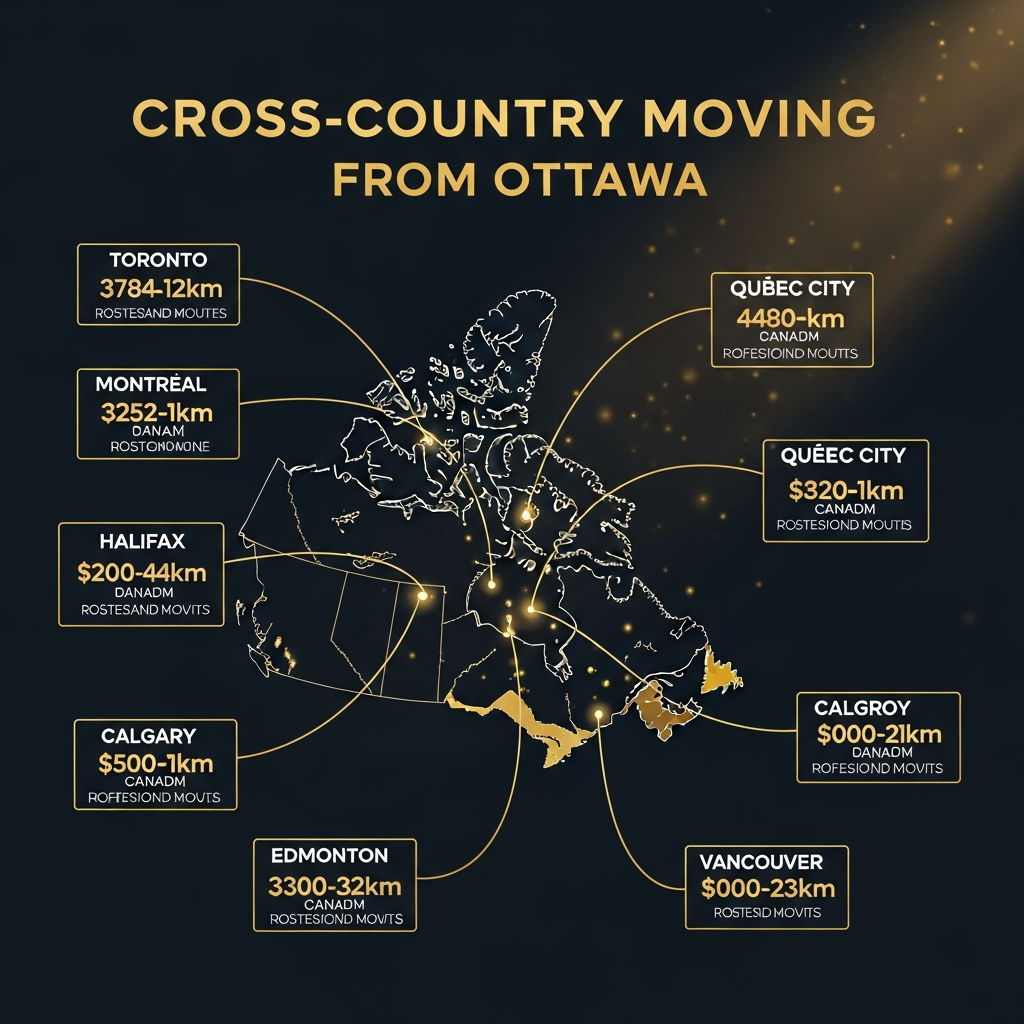
Cross-Country Moving Costs from Ottawa (2-Bedroom Home, 2026):
- Ottawa → Toronto (450 km): $1,800 – $4,500
- Ottawa → Montreal (200 km): $1,500 – $3,500
- Ottawa → Quebec City (450 km): $2,000 – $4,500
- Ottawa → Halifax (1,400 km): $3,500 – $7,500
- Ottawa → Winnipeg (2,200 km): $4,500 – $9,500
- Ottawa → Saskatoon (2,800 km): $5,500 – $11,000
- Ottawa → Calgary (3,400 km): $6,500 – $13,500
- Ottawa → Edmonton (3,500 km): $6,800 – $14,000
- Ottawa → Vancouver (4,400 km): $8,500 – $17,000
- Ottawa → Whitehorse (5,300 km): $12,000 – $22,000+
How Cross-Country Pricing Actually Works
Unlike local moves (typically priced hourly), cross-country moves are priced based on three factors:
- Weight (or cubic footage): The total weight of your shipment, calculated at the origin scale. Standard pricing is roughly $0.50–$1.50 per pound depending on distance and route.
- Distance: Total kilometres from origin to destination. Longer routes always cost more per pound.
- Service level: Standard, expedited, premium (climate-controlled, GPS tracked, dedicated truck), or budget (consolidated/shared load).
What Increases the Final Price
- Specialty items: Pianos, pool tables, hot tubs, gun safes, and antiques add significant cost.
- Stairs at either location: Each flight typically adds $50–$150 per crew, per direction.
- Long carry distance: If the truck cannot park within 75 feet of the door, additional charges apply.
- Storage: If items need to be stored between origin and destination, daily rates apply.
- Packing services: Full-service packing adds $500–$3,000 depending on home size.
- Insurance upgrade: Full-value protection adds 1–3% of declared value.
- Peak season: May–September moves carry 15–30% premiums.
What Reduces the Final Price
- Off-season booking: January–March moves are 20–30% cheaper than summer.
- Consolidated (shared-load) shipping: Combining your shipment with others reduces costs by 25–40% but extends transit time.
- Flexibility on delivery dates: Wider delivery windows allow movers to optimize routes.
- Decluttering before the move: Less weight = lower cost. A serious purge can save thousands.
- Self-packing: Saves $500–$3,000 in packing labour, though you still pay for materials.
Choosing the Right Cross-Country Moving Company
Cross-country moves are where the difference between professional and amateur movers becomes financially devastating. A bad local move costs you a few hundred dollars and a damaged dresser. A bad cross-country move can mean a destroyed household, weeks of legal disputes, and tens of thousands of dollars in losses.
Required Credentials for Cross-Country Movers
- Federal interprovincial moving licence: Required for all interprovincial moves under Canadian Transportation Agency regulations.
- Canadian Association of Movers (CAM) membership: Industry self-regulation body with mandatory ethical standards.
- $2 million+ commercial general liability insurance.
- $100,000+ cargo coverage per vehicle minimum.
- Full-value protection insurance available (mandatory upgrade for cross-country).
- Provincial registrations in both origin and destination provinces.
- WSIB compliance in Ontario plus equivalent workers' compensation in destination province.
Critical Questions for Every Quote Provider
- "How many cross-country moves to my specific destination do you complete per month?"
- "Do you use your own trucks and crew, or do you sub-contract long-haul to other carriers?"
- "What's the typical transit time and how is it guaranteed?"
- "How does your full-value protection insurance work, and what's the deductible?"
- "Can I track my shipment in real-time during transit?"
- "What happens if there are weather delays or mechanical breakdowns en route?"
- "What's your damage claim resolution time and process?"
- "Do you provide a binding written quote or just an estimate that can change?"
Major Red Flags to Avoid
- Verbal-only or email-only quotes: Without a binding written quote, the final price can be much higher.
- Cash-only or wire-transfer-only payment: Always reject. Reputable companies accept credit cards.
- Suspiciously low quotes: The cheapest cross-country quote is almost always the worst.
- Pressure tactics: "Book today or the price doubles" is a scam playbook.
- No physical address: Companies operating only from a phone number with no listed location.
- Hostage-load tactics: Refusing to deliver until additional unexpected charges are paid. This has been a documented scam pattern in Canadian long-distance moving.
- No real-time tracking: Modern movers use GPS tracking. The absence of it suggests under-investment.
- Sub-contracting without disclosure: If your move is handed off to a different company en route, you have no recourse if problems arise.
Choose trusted Ottawa long distance movers with documented credentials, transparent pricing, and verifiable customer reviews specifically mentioning your destination city.
Major Routes: Ottawa to Every Canadian Destination
Ottawa to Toronto (450 km, 4–5 hours)
Highway 401 West is the standard route. Single-day completion is normal for most moves. Cost-effective due to short distance and high competition between Ottawa and GTA movers. For comprehensive route guidance, see our Toronto-to-Ottawa moving guide.
Ottawa to Montreal (200 km, 2–3 hours)
Highway 417 East to Autoroute 40. Same-day completion is standard. See our detailed Ottawa-to-Montreal moving guide.
Ottawa to Quebec City (450 km, 5 hours)
Highway 417 East to Autoroute 40, then connecting to Autoroute 20 East. French-language considerations similar to Montreal moves. Best handled by movers with bilingual capability.
Ottawa to Halifax (1,400 km, 16 hours / 2 days)
Highway 417 East through Quebec, becoming Autoroute 20 then Autoroute 85 to New Brunswick. Continues as Highway 2 (Trans-Canada) to Nova Scotia. Typical transit: 2 days driving plus loading/unloading. Maritime weather can extend transit in winter.
Ottawa to Winnipeg (2,200 km, 24+ hours / 3 days)
Highway 417 West through Toronto, then Trans-Canada Highway 17 along Lake Superior, then Highway 11 across Northern Ontario. The Northern Ontario stretch (Sudbury to Thunder Bay) is remote with limited services — requires experienced long-haul drivers.
Ottawa to Calgary (3,400 km, 38+ hours / 4–5 days)
Standard route is Trans-Canada Highway 17 through Northern Ontario, then Highway 1 across the Prairies. Some movers use the I-94 / I-90 route through the United States (faster but requires customs documentation for Canadian household goods — usually only used for empty truck repositioning, not loaded moves).
Ottawa to Edmonton (3,500 km, 39+ hours / 5 days)
Similar to Calgary route until Saskatoon, then Highway 16 (Yellowhead Highway) west to Edmonton.
Ottawa to Vancouver (4,400 km, 48+ hours / 5–7 days)
The longest standard cross-country move from Ottawa. Trans-Canada Highway 1 west through Alberta and BC, crossing the Rocky Mountains via Kicking Horse Pass. Mountain weather can significantly delay transit October–April.
Ottawa to St. John's, NL (3,000 km + ferry, 5–7 days)
Halifax route plus 16-hour ferry from North Sydney, NS to Port aux Basques, NL. Moves to Newfoundland require ferry booking coordination and additional logistics.
Ottawa to Whitehorse, YT (5,300 km, 6–8 days)
Cross-Canada to Edmonton, then Alaska Highway through BC and Yukon. Specialized northern movers required. Limited services along route — careful planning essential.
Full-Service vs Consolidated (Shared Load) Moves
Cross-country movers offer two fundamentally different shipping options. Understanding the trade-offs is essential to making the right choice for your situation.
Full-Service Direct Moves
An entire truck is dedicated to your shipment. The truck loads at your Ottawa origin, drives directly to your destination, and unloads. No other shipments share the truck.
Advantages:
- Fastest transit times (no detours for other deliveries).
- Reduced handling — items are loaded once and unloaded once.
- Predictable delivery dates.
- Lower damage risk due to fewer handling events.
- Better suited for fragile or high-value items.
Disadvantages:
- Significantly more expensive (typically 30–50% premium over consolidated).
- Best value for larger moves (3+ bedrooms) where the truck is full.
Consolidated (Shared Load) Moves
Your shipment is combined with other households' belongings on the same truck. The truck makes multiple stops along its route.
Advantages:
- Significantly cheaper (25–40% cost reduction).
- Best value for smaller shipments (studio to 2-bedroom).
- Good for flexible delivery windows.
Disadvantages:
- Longer transit times (delivery windows of 7–21 days are common).
- Less predictable delivery dates.
- More handling events (multiple loads/unloads at consolidation centres).
- Higher damage risk for fragile items.
- Items may be temporarily stored at consolidation hubs.
Container-Based Moves
A sealed shipping container is delivered to your home for loading. Once loaded, the container is transported via truck or rail to your destination.
Advantages:
- Self-loading reduces costs.
- Container can serve as temporary storage during transition.
- Once loaded, container is sealed — no additional handling until destination.
Disadvantages:
- Customer responsible for proper loading and securement.
- Slower than dedicated truck transport.
- Limited to standard container sizes.
💡 Pro Tip: For most 1–2 bedroom moves over 1,000 km, consolidated shipping offers the best value. For 3+ bedroom moves or shipments with valuable furniture, dedicated full-service is worth the premium. Cross-country movers from Ottawa will help you weigh the trade-offs based on your specific circumstances.
Packing for Cross-Country Transit
Packing for a cross-country move is fundamentally different from packing for a local move. Items will be in transit for days, handled multiple times, exposed to temperature variations, and may shift inside trucks or containers over thousands of kilometres of road. Standard packing techniques will not work.
Box Quality Standards
- Use only new, sturdy moving boxes — never reused grocery store boxes or recycled cardboard.
- Standard sizes: small (1.5 cu ft), medium (3 cu ft), large (4.5 cu ft), extra-large (6 cu ft). Use small boxes for heavy items, large boxes for light bulky items.
- Specialty boxes: dish-pack (double-walled for kitchenware), wardrobe boxes (for hanging clothes), mirror cartons (for framed art), mattress bags (for mattresses).
Packing Techniques for Long-Haul
- Wrap every fragile item individually: Bubble wrap or unprinted packing paper. Newsprint can transfer ink onto items over long transit.
- Double-box exceptionally fragile items: Inner box wrapped, then placed inside a larger box with packing material on all sides.
- Fill all empty space inside boxes: Crumpled paper or packing peanuts. Empty space allows shifting and crushing.
- Box weight maximum 50 lbs: Heavier boxes risk handler injury and box failure.
- Tape every seam: Top, bottom, and reinforcing tape across all seams.
- Label clearly with destination, contents, and "FRAGILE" or "THIS SIDE UP".
Items That Require Special Attention
- Electronics: Original packaging is ideal. If unavailable, custom-padded boxes with anti-static wrap. Remove batteries before packing.
- Artwork: Mirror cartons or custom crates. Never lay artwork flat — always pack on its edge.
- Books: Small boxes only. Filled boxes can weigh 60+ lbs at full size — break loads into smaller boxes.
- Clothing: Wardrobe boxes for anything you'd hang. Folded items in regular boxes or vacuum bags.
- Kitchenware: Dish-pack boxes only. Each dish wrapped, stacked vertically (not horizontally) inside the box.
Items That Cannot Travel Long Distance
- Perishable food (use up or donate).
- Plants (subject to provincial agricultural restrictions, especially BC).
- Hazardous materials (paints, solvents, propane, chemicals).
- Ammunition and firearms (require separate transport per Canadian law).
- Pets (must travel separately by air or with you in your vehicle).
- Important documents (always travel with you, never with the truck).
- Cash, jewellery, and small valuables (always travel with you).
Insurance and Liability for Long-Haul Moves
Insurance is the most important consideration for any cross-country move and the area where customers most frequently make costly mistakes. Standard "released-value protection" — the default coverage included with most cross-country moves — pays $0.60 per pound of damaged or lost items. A 100-lb shipment of electronics destroyed in transit pays $60 in compensation. Don't accept this default.
Coverage Types Explained
- Released-value protection: The default. $0.60 per pound. Inadequate for any meaningful items.
- Full-value protection: The mover is liable for the actual cash value of damaged or lost items, up to a declared value. Typically adds 1–3% of declared value to the move cost.
- Third-party transit insurance: Independent insurance policy purchased separately. Usually higher coverage limits and clearer claim processes than mover-provided coverage.
- Specialty riders: Additional coverage for high-value items (artwork, antiques, musical instruments, jewellery).
How to Properly Document a Cross-Country Move
- Inventory list: A detailed list of every item shipped, with declared values for high-value items.
- Photos: Photograph every major piece of furniture, every electronic, and every artwork from multiple angles before packing.
- Bill of lading: Sign carefully — this is your contract with the mover. Note any pre-existing damage on items.
- Inspection at destination: Inspect every box and piece of furniture as it comes off the truck. Note damages on the bill of lading before signing for delivery.
- Claim filing: File any claims within the deadline specified in your contract (typically 30–90 days).
Bonded and Insured Means Nothing Without Documentation
"Bonded and insured" is a phrase used by every moving company. What matters is the specific coverage limits, the deductible, the claims process, and the company's track record on claim resolution. Always request documentation:
- Certificate of commercial general liability insurance ($2M+).
- Certificate of cargo insurance ($100K+ per vehicle).
- WSIB (or equivalent) coverage certificate.
- Sample claims policy and resolution timeline.
⚠️ Cross-Country Insurance Reality: Cross-country moves have multiple handling events at consolidation centres, weather exposure, and longer time windows during which damage can occur. The risk of damage is exponentially higher than local moves. Always upgrade to full-value protection. The cost (1–3% of declared value) is the cheapest insurance you'll ever buy.
Storage Options During Cross-Country Moves
Many cross-country moves require storage at one or both ends — the new home isn't ready, the move spans a longer transition period, or items need temporary space during construction or renovation. Most professional cross-country movers offer integrated storage as part of the move package.
Origin Storage in Ottawa
If you need to vacate your Ottawa home before your destination is ready, your mover can store your shipment in their Ottawa warehouse. Standard rates: $50–$200 per month per shipment, depending on volume.
In-Transit Storage
For longer moves (Ottawa to Vancouver), shipments may pass through consolidation hubs in Toronto, Winnipeg, or Calgary. These hubs serve as temporary storage during route optimization.
Destination Storage
If your new home isn't ready when the truck arrives at the destination city, your mover can deliver to a local storage facility for short-term holding. Most movers maintain partnerships with destination storage providers.
Climate-Controlled vs Standard Storage
For longer storage (over 30 days) or for items sensitive to temperature/humidity, climate-controlled storage is essential. Standard storage units are uninsulated metal — temperature inside ranges from -30°C to +40°C across Canadian seasons. Climate-controlled units maintain consistent 18–22°C and 35–55% humidity year-round.
Items requiring climate-controlled storage:
- Wood furniture (especially antiques).
- Leather furniture.
- Pianos and other musical instruments.
- Electronics.
- Photographs, artwork, and documents.
- Wine collections.
- Delicate fabrics and textiles.
Storage Cost Comparison
- Standard 5x10 unit: $80–$150/month
- Standard 10x10 unit: $130–$250/month
- Standard 10x20 unit: $200–$400/month
- Climate-controlled premium: Add 30–50% to standard rates
- Mover-provided storage (full-shipment): $50–$200/month for typical 1-2 bedroom shipments
What to Expect on a Multi-Day Cross-Country Move
Day 1 (Pre-Move): Final Preparation
The day before pickup, finalize your packing, prepare the moving day essentials bag (documents, chargers, snacks, water, basic toiletries for travel), and confirm pickup time with your mover.
Day 2 (Pickup Day): Loading in Ottawa
The crew arrives, conducts a walk-through, protects floors and door jambs, and begins loading. For a typical 2-bedroom move, expect 4–8 hours from arrival to truck departure. The crew lead reviews the inventory list with you, you sign the bill of lading, and the truck departs for the destination city.
Days 3–N (Transit): Tracking Your Shipment
Modern cross-country movers provide real-time GPS tracking via web portal or app. Transit times vary by destination:
- Ottawa to Toronto: 1 day
- Ottawa to Halifax: 2–3 days
- Ottawa to Winnipeg: 3–4 days
- Ottawa to Calgary: 4–5 days
- Ottawa to Vancouver: 5–7 days
For consolidated (shared-load) shipments, transit time can be 7–21 days depending on route and stops.
Destination Day: Delivery and Setup
The mover contacts you 24–48 hours before estimated delivery to confirm timing. On delivery day, the destination crew arrives, you direct furniture placement room by room, and items are unpacked or unloaded based on your service level. Inspect every item as it comes off the truck. Note any damage on the bill of lading before signing.
Post-Move: Claims and Settlement
If damage occurred, file claims within the contract deadline (typically 30–90 days). Provide photos, documentation, and itemized values. Reputable movers resolve claims within 30–60 days of filing.
Moving Vehicles Across Canada
If you're moving cross-country, you also need to figure out how to get your car (and possibly second vehicles, motorcycles, RVs) to your new home. There are three main options:
Option 1: Drive It Yourself
Most direct option for short and medium distances. Beyond Toronto or Montreal, expect 3–7 days of driving with hotel and food costs typically running $1,500–$3,500 for cross-country trips.
Option 2: Auto Transport (Ship the Vehicle)
Specialized auto transport companies move vehicles via car carrier trucks. Costs:
- Ottawa to Toronto: $400–$800
- Ottawa to Halifax: $800–$1,400
- Ottawa to Winnipeg: $900–$1,500
- Ottawa to Calgary: $1,200–$2,000
- Ottawa to Vancouver: $1,500–$2,500
Open carriers are cheaper; enclosed carriers protect against road debris and weather (premium for valuable vehicles).
Option 3: Train (For Some Routes)
VIA Rail offers limited auto-train service on some routes. Less common for moves, but sometimes available.
Vehicle Registration Considerations
If you're moving permanently to a new province, your vehicle must be re-registered in that province within the legal timeframe (typically 30–90 days). This includes:
- Provincial safety inspection.
- New plates and registration.
- Updated auto insurance.
- Driver's licence exchange.
Common Cross-Country Moving Mistakes to Avoid
Mistake #1: Not Getting Multiple Quotes
Cross-country quotes vary by 30–50% between companies for identical service. Always get 3+ quotes from CAM-member movers.
Mistake #2: Accepting the Lowest Quote Without Investigation
The cheapest cross-country quote is almost always the worst. Either bait pricing (with hidden fees added later), sub-contracted moves with no accountability, or under-insured operators who can't survive a claim.
Mistake #3: Skipping Full-Value Protection
Released-value protection ($0.60/lb) is woefully inadequate for cross-country shipments. Full-value protection costs 1–3% of declared value — the cheapest insurance you'll ever buy.
Mistake #4: Not Documenting Items Before the Move
Without photos and inventory lists, damage claims are nearly impossible to win. Document everything before packing.
Mistake #5: Packing Hazardous Materials
Paint, propane, lithium batteries, firearms, ammunition, and many cleaning products cannot legally be transported by movers. Confiscation or refusal to load is the best outcome — fire damage to your shipment is the worst.
Mistake #6: Not Updating Insurance and Address Information
Auto insurance, home insurance, banks, government accounts, subscriptions, and medical providers all need address updates. Failure to update can cause coverage lapses, missed bills, and legal complications.
Mistake #7: Underestimating Transit Time
Many homeowners don't plan for the 5–7 days their shipment is in transit to Vancouver. Plan accordingly — pack a "live without" bag for the transit period including clothes, toiletries, electronics, and documents.
Mistake #8: Choosing Movers That Sub-Contract Without Disclosure
Some "moving companies" are actually brokers who sell your move to whichever sub-contractor will take it cheapest. You have no recourse with the actual carrier. Always verify the company has its own trucks and crew.
Frequently Asked Questions About Cross-Country Moving
How much does it cost to move from Ottawa to Vancouver?
For a 2-bedroom home, expect $8,500–$17,000 in 2026, depending on weight, service level (consolidated vs dedicated), and timing. Off-season moves (January–March) can be 20–30% cheaper than summer moves.
How long does an Ottawa to Vancouver move take?
Direct dedicated truck moves typically transit in 5–7 days. Consolidated shared-load shipments take 10–21 days due to multiple stops along the route.
What's the cheapest way to move cross-country from Ottawa?
Consolidated shared-load shipping with off-season timing (January–March) and self-packing offers the lowest professional cost. DIY truck rental is occasionally cheaper for very small moves but carries significant fuel, hotel, food, and damage risks.
Can I track my shipment during a cross-country move?
Yes — modern cross-country movers provide real-time GPS tracking via web portal or app. If a mover doesn't offer tracking, that's a significant red flag.
What insurance do I need for cross-country moving?
At minimum, upgrade to full-value protection (1–3% of declared shipment value). For high-value items (artwork, antiques, electronics), purchase additional specialty riders or third-party transit insurance.
Can I ship my car along with my household goods?
Some cross-country movers offer auto transport as part of their service. More commonly, vehicles are shipped separately via specialized auto transport companies. Costs range from $400 (Toronto) to $2,500 (Vancouver) depending on distance.
Do cross-country movers pack for me?
Most offer full-service packing as an add-on. Costs typically run $500–$3,000 depending on home size. Self-packing is the most common cost-saving choice.
What can't I ship cross-country?
Hazardous materials (paint, propane, solvents), ammunition, firearms (separate transport required), perishable food, plants (some interprovincial restrictions), live animals, and important documents/valuables (always travel with you).
How far in advance should I book a cross-country mover?
For peak season (May–September), book 6–12 weeks in advance. Off-season moves can typically be booked 4–6 weeks ahead. Last-minute cross-country moves are possible but limit your choice of carriers.
What happens if my shipment is delayed?
Reputable movers communicate proactively about delays and may offer compensation for extended delays beyond contracted delivery windows. Always review the delivery window and delay policies in your contract.
Is it worth it to hire professional cross-country movers vs DIY?
For most households, yes. DIY truck rental for a 2-bedroom move from Ottawa to Vancouver costs $3,000–$5,000 in truck rental alone, plus fuel ($1,500–$2,500), hotels and food ($1,500–$2,500), and the time and physical effort of driving 4,400 km. Professional cross-country movers typically cost $8,500–$17,000 with significantly less risk and zero physical labour.
What's the best cross-country moving company from Ottawa?
Look for federal interprovincial licensing, CAM membership, $2M+ liability insurance, full-value protection availability, real-time GPS tracking, and verifiable customer reviews specifically mentioning cross-country moves to your destination. Best long distance movers in Ottawa handle every aspect of cross-country moves with full transparency and accountability.
Ready to Move Cross-Country from Ottawa? Whether you're heading to Halifax, Winnipeg, Calgary, Vancouver, or anywhere across Canada, the right cross-country movers make all the difference. Call (613) 600-4000 for a free, no-obligation cross-country moving quote, or visit our free quote page to get pricing in under 2 minutes.