Why Moving Between Ottawa and Montreal Is Different
The Ottawa-Montreal corridor is one of Canada's most active inter-city moving routes. Hundreds of households make this move every year — government workers transferred between offices, tech professionals shifting between Kanata and Mile End, families relocating for affordability, students moving for university, and retirees heading to Quebec's lower property taxes. The two-hour drive on Highway 417 / Autoroute 40 makes it deceptively simple. But there's far more to a successful Ottawa-to-Montreal move than just driving the truck.
Unlike a local Ottawa move, an Ottawa-to-Montreal relocation crosses a provincial border. That means different healthcare systems, different driver's licence requirements, different school registration processes, French-language paperwork, Quebec-specific tax obligations, and Quebec's unique consumer protection laws governing residential moves.
Most Ottawa to Montreal moving companies handle the physical transport without issue. The harder part is the logistics surrounding the move — and that's where experienced cross-province movers earn their fee. They know which neighbourhoods require advance freight elevator booking, which Montreal arrondissements have parking permit requirements, and how Quebec's mandatory consumer contracts differ from Ontario's.

Why People Move Between Ottawa and Montreal
- Government and federal jobs: Federal employees frequently transfer between the National Capital Region and Quebec's regional federal offices.
- Tech sector: Montreal's growing AI and gaming industries (Element AI, Ubisoft, Mila) attract talent from Ottawa's Kanata North tech park.
- Cost of living: Montreal's housing market — particularly off-island — offers significantly lower prices than Ottawa proper.
- Education: McGill University, Université de Montréal, Concordia, and HEC Montréal draw students from across the NCR.
- Bilingualism: Families seeking French immersion environments often choose Montreal.
- Lifestyle: Montreal's food, arts, and cultural scene draws Ottawa residents seeking a more cosmopolitan environment.
Ottawa to Montreal Moving Costs: Complete 2026 Pricing
The good news about Ottawa-to-Montreal moves: the relatively short distance (200 km) keeps costs significantly lower than other long-distance moves from Ottawa. Here's what to budget in 2026:
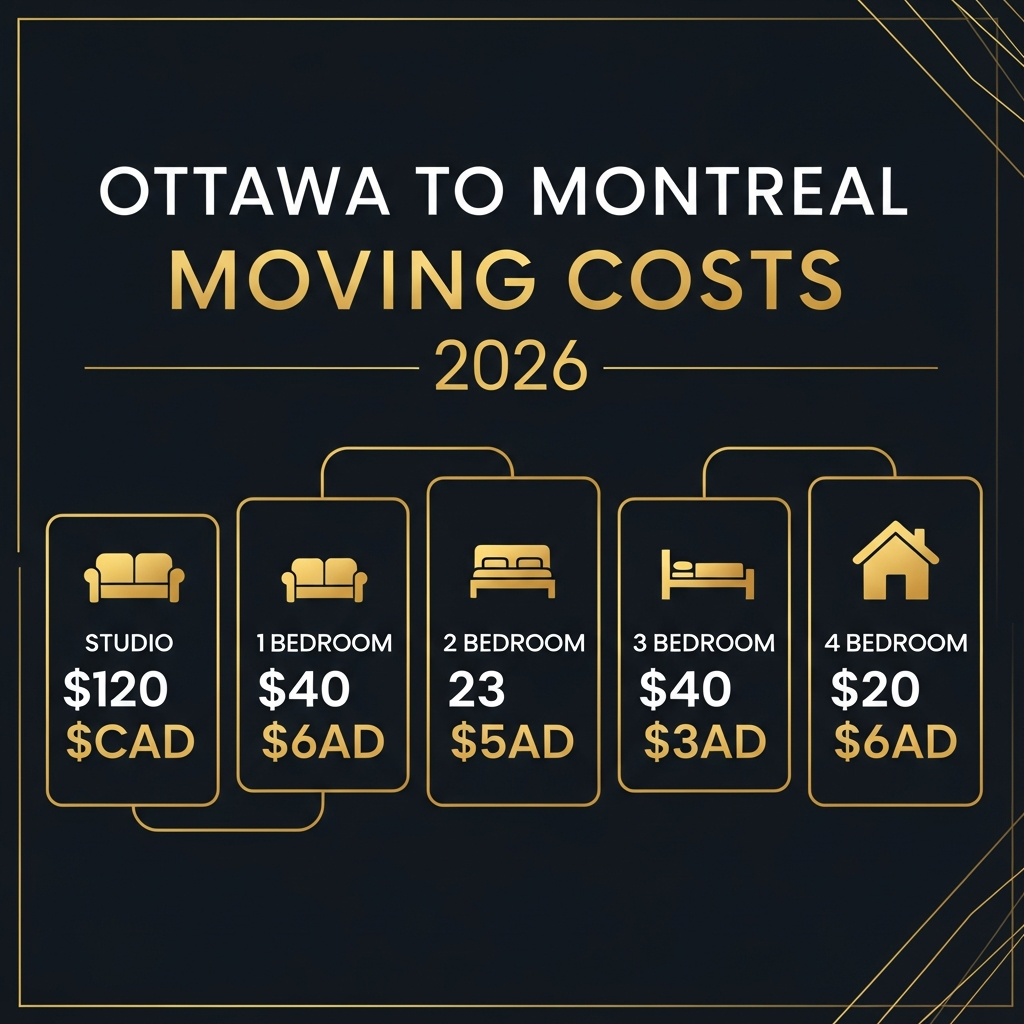
Ottawa to Montreal Moving Costs (2026):
- Studio apartment: $700 – $1,400
- 1-bedroom apartment or condo: $1,000 – $2,000
- 2-bedroom condo or townhouse: $1,800 – $3,200
- 3-bedroom house: $2,800 – $5,000
- 4+ bedroom house: $4,500 – $8,500
- Single piano (upright): $400 – $800
- Single piano (grand): $1,200 – $2,500
- Specialty items (pool table, gun safe, hot tub): $600 – $2,500 each
What Drives Ottawa-Montreal Moving Costs
- Total weight or cubic footage: Most cross-province moves are priced by weight (per pound) or cubic footage rather than hourly. The more stuff you have, the higher the cost.
- Distance from each address to highway: Pickup and delivery in dense urban areas (Plateau Mont-Royal, Le Sud-Ouest, Vieux-Montréal) takes more time than suburban deliveries.
- Stairs and elevators: Montreal's classic walk-up triplexes (with iconic exterior staircases) add significant labour. Expect $100–$300 in additional charges per flight without an elevator.
- Parking restrictions: Many Montreal neighbourhoods require advance moving permits and have strict parking enforcement. Some movers handle permit acquisition; others charge it back.
- Date and timing: July 1st (Quebec's "Moving Day" / "Jour du déménagement") is the busiest moving day in North America. Expect 30–50% premium pricing within a 2-week window of July 1st.
- Insurance level: Released-value (default) vs. full-value protection. Always upgrade for cross-province moves.
- Packing services: Full-service packing adds $400–$1,500 depending on home size.
The July 1st Quebec Moving Day Effect
Quebec's traditional July 1st lease turnover date concentrates an extraordinary volume of moves into a single week. Roughly 200,000 Quebec households move during this period, creating massive demand for trucks, crews, and storage. If you can avoid moving in late June or early July, do so — you'll save 30–50% and have far better mover availability.
Choosing the Right Ottawa to Montreal Moving Company
Not every Ottawa moving company is properly equipped for cross-province moves. Use this checklist when interviewing potential movers:
Required Credentials
- Interprovincial moving licence: Federally registered for moves across provincial borders.
- Quebec-specific compliance: Familiarity with Quebec consumer protection laws and the Office de la protection du consommateur (OPC) requirements.
- Bilingual capability: At minimum, French-speaking dispatch and crew members for Montreal-side coordination with building managers and customers.
- CAM membership: Canadian Association of Movers certification.
- Insurance: $2M+ commercial general liability, $100K+ cargo per vehicle, full-value protection available.
- Air-ride trucks: Essential for the 2-hour highway transit to protect furniture from vibration damage.
Questions to Ask Every Quote Provider
- "How many Ottawa-to-Montreal moves do you complete per month?"
- "Do you have French-speaking crew members for the Montreal side?"
- "How do you handle Montreal parking permits and street access restrictions?"
- "What's your experience with Montreal walk-up triplex moves?"
- "Are you registered with Quebec's OPC?"
- "Do you provide a binding written quote in both English and French?"
- "What's your damage claim resolution process across provinces?"
Red Flags Specific to Ottawa-Montreal Moves
- No knowledge of Montreal arrondissements or specific delivery challenges.
- Inability to communicate in French at all (a major concern for Montreal-side coordination).
- Phone-only quotes without home survey for moves over 1-bedroom in size.
- Suspiciously low quotes during peak season — likely either bait pricing or a sub-contracted crew.
- No knowledge of Quebec's mandatory consumer disclosure rules.
Experienced Ottawa long distance movers handling the Montreal corridor will provide bilingual service, written binding quotes, and detailed knowledge of both cities' moving logistics.
The Routes: Highway 417 and Beyond
The standard route between Ottawa and Montreal is Highway 417 east, becoming Autoroute 40 at the Quebec border. This is a 200 km drive, typically 2 hours in normal traffic. For moving trucks, expect 2.5–3 hours due to lower speed limits and the need for fuel stops.
Highway 417 / Autoroute 40 — The Standard Route
The most direct path. Crosses the Quebec border at the Ontario-Quebec line near Hawkesbury, then continues as Autoroute 40 (the Trans-Canada Highway) into Montreal. Major exits include Casselman, Hawkesbury, Rigaud, Vaudreuil-Dorion, Pointe-Claire, Dorval, and finally into Montreal proper.
Autoroute 20 — The Southern Alternative
Some movers prefer Autoroute 20 for deliveries to South Shore destinations (Brossard, Longueuil, Saint-Lambert). This route uses Highway 401 East to Cornwall, then connects to Autoroute 20 at the Quebec border. Slightly longer but often less congested for South Shore deliveries.
Highway 50 — Through Gatineau
Less commonly used for full moves due to slower speeds, but viable for Gatineau-origin moves. Highway 50 runs along the north side of the Ottawa River through the Outaouais region before connecting to Autoroute 50 in Quebec, eventually joining Autoroute 15 South to Montreal.
Highway Conditions to Plan Around
- Winter conditions (December–March): Snow and ice can extend transit time by 1–2 hours. Reputable movers track weather and reschedule when conditions are unsafe.
- Summer construction (May–October): Both Highway 417 and Autoroute 40 have ongoing construction projects. Check Quebec's 511 traffic system before moving day.
- Montreal traffic patterns: Avoid arrival in Montreal between 7–9 AM and 4–6 PM, especially on Friday afternoons.
- Bridge restrictions: The Champlain, Jacques-Cartier, and Honoré-Mercier bridges all have weight restrictions and time-of-day truck restrictions.
Quebec Neighbourhoods: Where People From Ottawa Move To
Montreal is divided into 19 boroughs (arrondissements), plus dozens of demerged municipalities and on-island and off-island suburbs. Where you move matters enormously — both for lifestyle and for moving logistics.
Most Popular Montreal Destinations for Ex-Ottawa Residents
Plateau Mont-Royal
The iconic Montreal neighbourhood — vibrant, walkable, full of duplexes and triplexes with exterior staircases. Highly desirable but extremely tight access. Most Plateau moves require parking permits and crew experience navigating those iconic spiral staircases.
Le Sud-Ouest (Saint-Henri, Griffintown, Pointe-Saint-Charles)
Rapidly gentrifying district with new condo developments mixed among industrial heritage buildings. Griffintown specifically is one of the fastest-growing neighbourhoods in Canada and a popular destination for Ottawa professionals.
Outremont
Affluent, leafy, and full of beautiful century homes. Higher-end moving requirements typically — expect to need experienced movers for fine furniture and antiques.
Rosemont–La Petite-Patrie
Family-friendly, increasingly popular for young professionals priced out of the Plateau. Mix of duplexes, triplexes, and newer condos.
Côte-des-Neiges–Notre-Dame-de-Grâce (CDN-NDG)
Diverse and central, popular with McGill and Université de Montréal students and faculty. Good mix of apartments and detached homes.
Côte-Saint-Luc, Hampstead, Westmount
Anglophone enclaves with established Jewish and English communities. Higher property values, larger homes, more straightforward moving access than central Montreal.
West Island (Pointe-Claire, Dollard-des-Ormeaux, Beaconsfield, Kirkland)
Suburban, family-oriented, predominantly anglophone. Easier access for moving trucks, larger lot sizes, more parking, and significantly cheaper than central Montreal.
South Shore (Brossard, Longueuil, Saint-Lambert)
Across the Champlain Bridge from Montreal. Brossard especially has seen explosive growth driven by the new REM light rail extension.
Laval
North of Montreal across the Rivière des Prairies. Suburban, family-oriented, and significantly more affordable than Montreal proper.
💡 Pro Tip: Tell your moving company specifically which arrondissement or suburb you're moving to. Each has different parking permit requirements, building access protocols, and traffic patterns. Long distance movers from Ottawa with regular Montreal experience know each neighbourhood's quirks.
What Changes When You Move from Ontario to Quebec
Crossing the provincial border is more than just a physical move — it's a regulatory transition. Here's what changes the moment you become a Quebec resident:
Government ID and Documentation
- Driver's licence: You have 90 days to exchange your Ontario licence for a Quebec licence at SAAQ (Société de l'assurance automobile du Québec).
- Health card: Apply for a RAMQ (Régie de l'assurance maladie du Québec) card immediately. There's a 3-month waiting period before coverage begins, so maintain Ontario coverage during this transition.
- Vehicle registration: Vehicles must be registered with SAAQ within 90 days. Includes safety inspection.
- Address update: Update Service Canada (SIN, federal benefits), Canada Revenue Agency, voter registration, and any banks/insurance providers.
Language Considerations
Quebec's Bill 96 reinforces French as the language of business and government. Most government services are conducted in French, although bilingual service is generally available in Montreal. New residents should expect to navigate paperwork in French and consider basic French language skills as essential.
Provincial Tax Filing
Quebec residents file two tax returns annually — federal (CRA) and provincial (Revenu Québec). Quebec uses its own tax forms and credits, separate from the rest of Canada. Most accounting software handles both, but plan for additional complexity at tax time.
Real Estate and Tenancy Differences
- Lease terms: Most Quebec leases run July 1st to June 30th annually (the origin of the Quebec Moving Day tradition).
- Tenant protections: Quebec's tenant protections are among the strongest in Canada. Rent increases are capped, and evictions are difficult.
- Welcome tax (Taxe de bienvenue): Property buyers pay a one-time municipal welfare tax based on purchase price.
- Notary requirement: Real estate transactions in Quebec require a notary, not a lawyer (a unique civil-law tradition).
Schools and Education
Quebec's public schools are organized by language (French school boards and English school boards) and by religion (formerly Catholic and Protestant, now secular). New residents must understand Bill 101 — the Charter of the French Language — which requires most children to attend French-language public schools unless certain eligibility criteria are met.
Healthcare, Schools, and Driver's License Transitions
RAMQ Healthcare Registration
The Régie de l'assurance maladie du Québec (RAMQ) administers Quebec's universal health coverage. New residents must:
- Register with RAMQ in person within the first months of arrival.
- Provide proof of Quebec residency (lease, property purchase, utility bills).
- Wait the mandatory 3-month qualification period before coverage begins.
- Maintain Ontario OHIP coverage during this transition (OHIP coverage continues for up to 3 months after leaving Ontario).
Some employers offer private insurance bridging the gap. Private insurance is also available for the 3-month waiting period.
Driver's Licence Exchange (SAAQ)
Ontario driver's licences can be exchanged for Quebec licences without retesting if exchanged within the first 6 months of residency. After that period, new residents must take Quebec's written and road tests. Visit any SAAQ service centre with:
- Current Ontario driver's licence.
- Proof of Quebec residency.
- Photo ID (passport or birth certificate).
- SAAQ exchange fee (varies — currently around $96).
Vehicle Registration
Vehicles registered in Ontario must be re-registered in Quebec within 90 days. Process includes:
- Surrender Ontario plates and registration.
- Pass Quebec safety inspection at any authorized garage.
- Register with SAAQ and pay registration fees.
- Update auto insurance to Quebec policy.
School Registration
School-age children must be registered with the appropriate Quebec school board within 30 days of arrival. Required documentation:
- Proof of residency in the school's catchment area.
- Birth certificate.
- Vaccination records.
- Previous school transcripts.
- For English schools: certificate of eligibility under Bill 101.
Tax and Financial Considerations Moving to Quebec
Quebec's tax system is more complex than other provinces because residents file separate provincial returns and pay distinct provincial taxes. Here's what to plan for:
Income Tax
Quebec has the highest provincial income tax rates in Canada. Combined federal + provincial marginal rates can exceed 53% at the top tier. However, Quebec also offers more generous tax credits — particularly for families with children, daycare costs, and seniors.
Sales Tax
Quebec uses GST (5%) plus QST (Quebec Sales Tax, 9.975%) for a combined 14.975%, slightly higher than Ontario's HST of 13%.
Property Tax and Welcome Tax
Property tax rates vary by municipality but are generally similar to Ontario. The notable addition is the "welcome tax" (Taxe de bienvenue / Droits de mutation immobilière) — a one-time municipal tax paid when purchasing property. Calculation:
- 0.5% on the first $58,900
- 1.0% on $58,900 – $294,600
- 1.5% on $294,600 – $552,300
- 2.0% on $552,300 – $1,104,700
- 2.5% above $1,104,700 (in Montreal specifically)
Vehicle and Insurance Costs
Quebec auto insurance is split between mandatory public coverage (SAAQ — bodily injury) and private coverage (vehicle damage and liability). Total costs are typically lower than Ontario for comparable coverage. Vehicle registration includes annual licensing fees plus a contribution to the SAAQ insurance fund.
Daycare
Quebec's subsidized daycare ($9.10/day in 2024) is dramatically cheaper than Ontario's market-rate childcare. For families with young children, this alone often justifies the Ottawa-to-Montreal move financially.
Key Takeaway: The Ottawa-to-Montreal move involves significant administrative work beyond the physical relocation. Plan for 2–3 months of transition paperwork after the move itself. Most experienced Ottawa to Montreal movers can recommend bilingual service providers (notaries, immigration consultants, accountants) to help navigate the transition.
Bilingual Service: Why It Matters for Ottawa-Montreal Moves
French is the official language of Quebec, and bilingual capability is essential for any Ottawa-to-Montreal move — especially on the destination side. Here's why it matters:
Building Manager Coordination
Most Montreal condo and apartment building managers communicate primarily in French. Coordinating freight elevator bookings, certificate of insurance submissions, and parking arrangements requires French communication.
Parking Permits
City of Montreal parking permits and signage are in French only. Crews and dispatchers must understand parking regulations, no-stopping zones, and time-of-day restrictions to avoid fines.
Quebec Consumer Contracts
Quebec law requires consumer contracts to be available in French. Many moving companies provide bilingual contracts to facilitate cross-province moves. Ensure your contract is provided in your preferred language.
Interactions with Authorities
If issues arise during the move (parking tickets, building disputes, damage claims), interactions with Montreal authorities will be in French. Bilingual mover support is crucial in these situations.
Customer Comfort
Even if the move's English-speaking customer is comfortable, family members on the receiving end (relatives, contractors, building staff) may prefer French. A mover with bilingual capability creates a smoother experience for everyone involved.
Always confirm with your Ottawa long distance moving company that they have French-speaking dispatchers and at least one French-speaking crew member assigned to your move.
How to Pack and Prepare for the Cross-Province Move
Packing for Long Distance Transit
Cross-province moves require sturdier packing than local moves. Items will be in transit for 4–8 hours, handled multiple times, and may experience temperature extremes. Use these guidelines:
- Use new, sturdy boxes: Reused grocery boxes are not strong enough for long-distance transport.
- Double-box fragile items: Glassware, porcelain, and electronics should be wrapped in bubble wrap inside one box, then nested inside a larger box with packing material between the two.
- Fully fill every box: Empty space inside boxes leads to crushed items. Fill gaps with crumpled paper or packing peanuts.
- Tape every seam: Top, bottom, and reinforcing tape across all seams.
- Label clearly: Room destination, contents summary, and "FRAGILE" or "THIS SIDE UP" where appropriate.
Pre-Move Quebec-Specific Tasks
- Confirm RAMQ application materials are ready for submission upon arrival.
- Organize school transcripts and vaccination records for child registration.
- Prepare proof-of-residency documents (signed lease, utility bills) for SAAQ and RAMQ.
- Cancel Ontario auto insurance and arrange Quebec coverage for arrival day.
- Notify your Ontario doctor and dentist of your move and request copies of medical records.
- Update your CRA and Service Canada address.
- Forward mail through Canada Post for 6 months minimum.
The Day Before the Move
- Charge phones and prepare a "moving day essentials" bag with documents, chargers, snacks, water, and basic toiletries.
- Confirm parking arrangements at both Ottawa and Montreal addresses.
- Review the binding quote and inventory list with the crew lead.
- Defrost and clean appliances if they're being moved.
Moving Back: Montreal to Ottawa Logistics
If you're moving from Montreal back to Ottawa, the same companies typically handle moves in both directions. The logistics reverse, but the considerations are similar:
Costs Are Similar
Pricing for Montreal-to-Ottawa moves is essentially identical to Ottawa-to-Montreal pricing. The truck travels the same distance regardless of direction.
Reverse Administrative Process
- Driver's licence: Exchange Quebec licence for Ontario at any ServiceOntario location.
- Health card: Apply for OHIP at ServiceOntario. The 3-month waiting period applies.
- Vehicle registration: Re-register vehicles in Ontario within 30 days.
- Tax filing: File final Quebec return, then file Ontario for the following year.
Choosing Movers for Montreal-to-Ottawa
The same criteria apply — interprovincial licensing, bilingual capability, air-ride trucks, full-value insurance. Many Ottawa-based movers handle both directions and offer return-trip discounts when their trucks are returning empty.
Why People Move Back to Ottawa
- Federal government job transfers.
- Family reasons (returning to be near aging parents or grandchildren).
- Healthcare considerations (English-language healthcare in Ottawa).
- Tax simplicity (single Ontario provincial return).
- Schools (English-language public schools more accessible in Ottawa).
- Weather (Ottawa's slightly milder winters compared to Montreal's snow accumulation).
Frequently Asked Questions About Ottawa-Montreal Moving
How much does it cost to move from Ottawa to Montreal?
Ottawa to Montreal moves typically range from $700 (studio apartment) to $8,500+ (large 4-bedroom house). The average 2-bedroom move costs $1,800–$3,200 in 2026. July moves carry a 30–50% premium due to Quebec Moving Day demand.
How long does an Ottawa to Montreal move take?
The drive itself is 2–3 hours. Total move time including loading and unloading is typically 8–12 hours for 1–2 bedroom homes, 1–2 days for 3+ bedroom houses. Some movers complete the move in a single day; others split loading and unloading across two days.
What's the best time of year to move from Ottawa to Montreal?
September–October and April–May offer the best weather, lowest prices, and best mover availability. Avoid late June and early July (Quebec Moving Day rush). Winter moves (December–March) are cheaper but require careful planning around snow and ice.
Do I need bilingual movers for Ottawa-Montreal moves?
Bilingual capability is strongly recommended for the Montreal side of the move. Building managers, parking enforcement, and many service providers in Montreal communicate primarily in French. Most professional Ottawa long distance movers maintain French-speaking dispatch and crew members.
How do I find an apartment in Montreal from Ottawa?
Use Kijiji Montréal, Centris.ca, Marketplace, and rental websites like Lou Lou or RentBoard. Many leases turn over July 1st, so plan apartment searching for May–June if targeting that date. Visit Montreal in person at least once before signing a lease.
Do I need to register my Ontario car in Quebec after moving?
Yes — within 90 days of becoming a Quebec resident. Vehicles must pass a Quebec safety inspection and be registered with SAAQ. Auto insurance must also transfer to a Quebec policy.
How long does it take to get Quebec health coverage?
RAMQ has a mandatory 3-month waiting period from the date you become a Quebec resident before coverage begins. During this period, your Ontario OHIP coverage typically extends, or you can purchase private bridge insurance.
Can my kids attend English school in Quebec?
Bill 101 restricts English-language public school access. Children are eligible if at least one parent received English-language instruction in Canada, or if they have a sibling currently attending English school. Otherwise, children must attend French-language public schools (or private schools in either language).
What's the average commute time in Montreal vs Ottawa?
Montreal's average commute is 30–40 minutes (longer than Ottawa's 25–30 minutes). However, Montreal's transit system (metro and bus network) is far more developed than Ottawa's, making car-free living realistic in central neighbourhoods.
Is the cost of living lower in Montreal than Ottawa?
Generally yes — particularly for housing. Average Montreal rent is 15–25% lower than Ottawa for comparable units. Daycare is dramatically cheaper ($9.10/day vs market rates). Groceries and restaurants are similar. Income tax rates are higher in Quebec, partially offsetting the savings.
Can I drive a moving truck across the Ontario-Quebec border?
Yes — there are no special permits required. Bridge tolls and weight restrictions apply for some routes (especially on Champlain, Jacques-Cartier, and Honoré-Mercier bridges in Montreal).
What's the best moving company for Ottawa to Montreal?
Look for companies with interprovincial licensing, bilingual French/English service, air-ride suspension trucks, full-value protection insurance, and documented experience on the Ottawa-Montreal route. Trusted Ottawa long distance movers with regular Montreal experience handle all aspects of cross-province logistics.
Ready to Move Between Ottawa and Montreal? Whether you're heading to a Plateau triplex, a Griffintown condo, or a West Island family home — or moving back to Ottawa from Montreal — the right cross-province movers make all the difference. Call (613) 600-4000 for a free, no-obligation Ottawa-Montreal moving quote, or visit our free quote page to get pricing in under 2 minutes.