Why Piano Moving Demands Specialists (Not Regular Movers)
A piano is unlike anything else in your home. It is simultaneously a precision musical instrument, a piece of fine furniture, and one of the heaviest, most awkwardly balanced objects most people will ever own. A standard upright weighs 300 to 500 pounds. A baby grand weighs 500 to 600 pounds. A full concert grand can exceed 1,400 pounds — most of it concentrated in a cast iron plate suspended inside a delicate wooden case under nearly 20 tons of string tension.
This is why hiring general movers for a piano move is one of the costliest mistakes Ottawa homeowners make. A single dropped corner can crack the soundboard. A scraped pedal lyre can mean a $2,000 repair. A tipped grand can shear the legs clean off. And once a piano is damaged structurally, it is rarely worth restoring — most "moved by general movers" claims end with the instrument being written off entirely.
The Piano Technicians Guild — the international body certifying piano technicians — recommends that any piano valued over $5,000 be moved exclusively by movers with documented piano-specific training, insurance riders for musical instruments, and the proper equipment (piano boards, piano dollies, four-wheel cranes for stairs).
Professional Ottawa piano movers approach every job with three non-negotiables: the piano leaves the origin without a scratch, it arrives at the destination in tune-ready condition, and the crew never improvises around stairs, narrow doors, or weather. That last point is critical in Ottawa, where heritage homes in The Glebe and Centretown frequently have staircases never designed to accommodate a 600-pound instrument on a piano board.
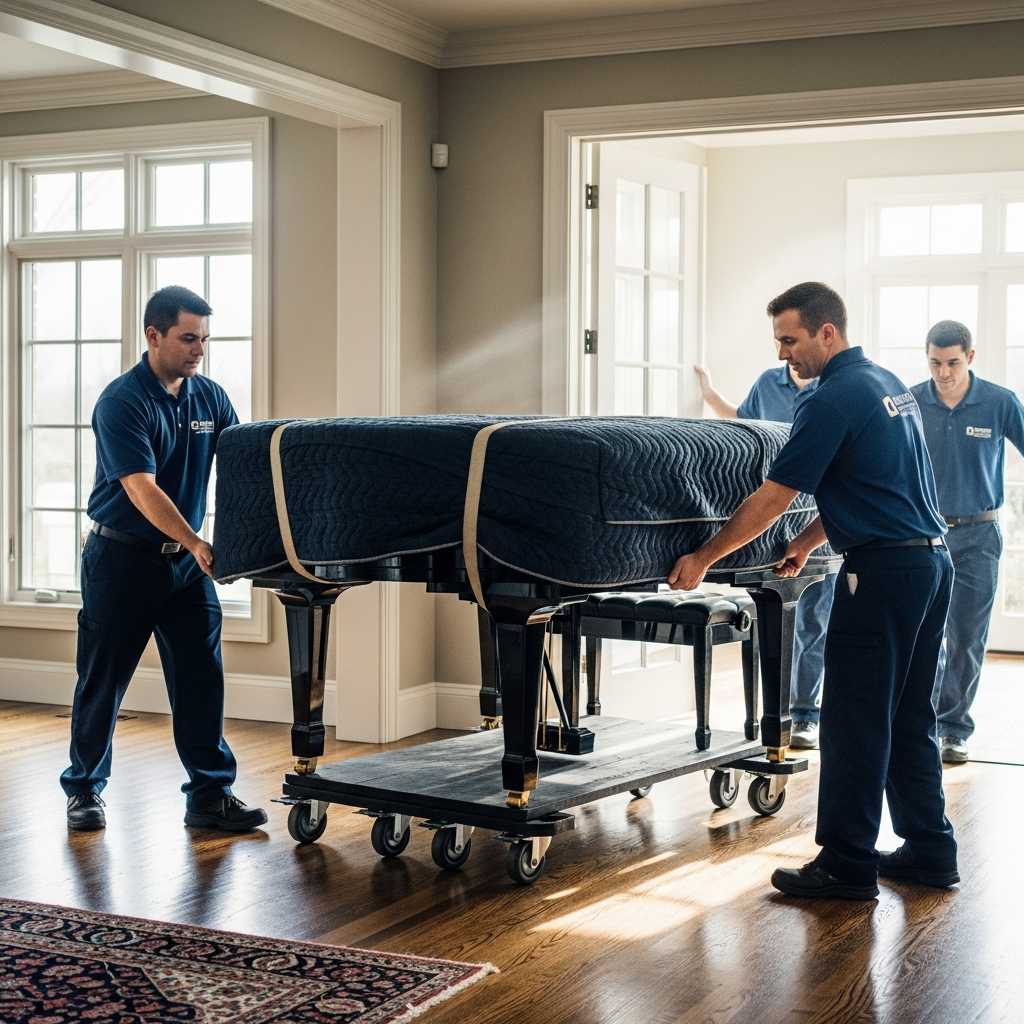
The Real Risk of Hiring Non-Specialists
Insurance is where the difference becomes brutal. Most general residential moving insurance covers furniture by weight — typically $0.60 per pound under basic released-value protection. A 600-pound grand piano damaged beyond repair would pay out roughly $360. Specialist piano movers carry musical instrument riders that cover replacement value, often up to $250,000 per piano. If your instrument is worth more than a used car, this distinction matters enormously.
Types of Pianos and How They Move Differently
Before you can budget or plan, you need to know exactly what kind of piano you own. The moving technique, equipment, crew size, and cost vary dramatically by piano type — and quotes from piano movers in Ottawa will be wildly different depending on what's coming down the hallway.
Upright (Vertical) Pianos
Spinet, console, studio, and full upright pianos all stand vertically with strings running up and down. They are the most common type in Ottawa homes and the simplest to move. Typical weights: spinet 300–400 lbs, console 350–450 lbs, studio 450–550 lbs, full upright 500–800 lbs. They are moved upright on a four-wheel piano dolly, secured with straps and quilted blankets. A two-person crew handles most upright moves; three are required for full uprights or stair work.
Baby Grand and Grand Pianos
Grand pianos are horizontal — strings run front to back parallel to the floor. They cannot be moved as-is. The lid is closed and locked, the music desk and pedal lyre are removed, the legs are unbolted one at a time while the piano is supported on a piano board (also called a piano skid), and the entire instrument is then transported on its side. Sub-categories by length:
- Petite grand: Under 4'11" — 450–550 lbs
- Baby grand: 4'11" to 5'6" — 500–650 lbs
- Medium grand: 5'7" to 6'4" — 600–750 lbs
- Parlor / professional grand: 6'5" to 7'4" — 700–900 lbs
- Semi-concert grand: 7'5" to 8'11" — 900–1,200 lbs
- Concert grand: 9' and longer — 1,200–1,400+ lbs
Steinway, Yamaha, Bösendorfer, and Fazioli all publish detailed handling guidance for their instruments. Steinway's official moving recommendations are the gold standard most professional Ottawa piano movers train against.
Digital and Hybrid Pianos
Digital pianos (Yamaha Clavinova, Roland LX, Kawai CA series, Casio Privia) are dramatically lighter — usually 100 to 200 lbs — but contain delicate sensors, hammers, and electronic boards that should never be jostled. They typically require disassembly of the bench, music rest, and sometimes the keyboard from the stand. Treat them like a high-end appliance, not a piano.
Player Pianos and Antique Squares
Player pianos and antique square grands are heavier and more fragile than their modern counterparts. Player mechanisms add 100+ lbs and contain pneumatic systems that can be permanently damaged by tilting. Antique square grands (1840s–1880s) are exceptionally fragile and often legally considered heritage objects — these moves should always be handled by specialists with antique experience.
Piano Moving Costs in Ottawa: Complete 2026 Pricing Breakdown
Cost is the question every Ottawa homeowner asks first, and the honest answer is: it depends on five things — piano type, distance, stairs, access, and timing. Here are realistic 2026 numbers from professional piano movers in Ottawa:
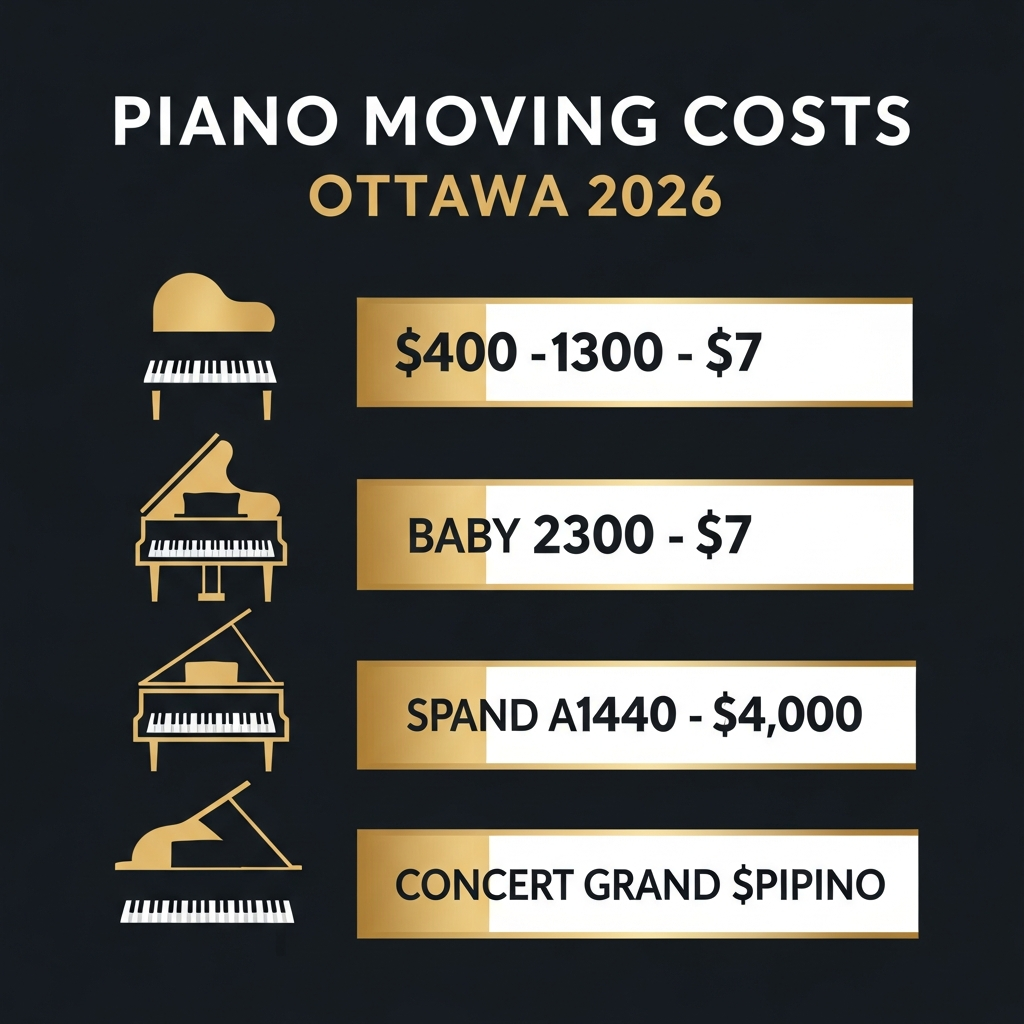
Average Piano Moving Costs in Ottawa (2026):
- Upright piano (local, ground floor to ground floor): $250 – $450
- Upright piano (with one flight of stairs): $400 – $650
- Baby grand (local, single floor): $500 – $800
- Baby grand (with stairs or tight access): $750 – $1,200
- Grand piano (6'+, local move): $800 – $1,500
- Concert grand (9'+): $1,500 – $3,000+
- Long distance (Ottawa to Toronto / Montreal): $1,200 – $3,500 depending on size
- Climate-controlled storage (per month): $80 – $200
What Drives the Final Number
- Stairs: The single biggest cost multiplier. Each flight typically adds $75–$150 for an upright and $150–$300 for a grand. Spiral or curved staircases can add $300+ and may require a four-person crew.
- Access: Long carries from truck to door, narrow hallways requiring door removal, low ceilings on landings, and tight elevator dimensions all add labour time.
- Hoisting / cranes: If a grand piano cannot fit through a doorway or staircase, it may need to be hoisted through a window or balcony. This is rare but adds $500–$2,000.
- Distance: Local moves within Ottawa are flat-rate. Anything beyond the National Capital Region shifts to per-kilometre or long-distance pricing.
- Timing: Same-day, after-hours, and weekend moves carry 25–50% premiums. Booking 2+ weeks in advance gives you the best rates.
- Insurance upgrade: Standard coverage is included; full replacement-value piano insurance riders typically add $50–$200 depending on appraised value.
💡 Pro Tip: Always get an in-home or detailed virtual estimate before committing. Phone quotes for piano moves are notoriously unreliable because the mover hasn't seen the staircase, doorway widths, or pathway. Reputable professional piano moving services in Ottawa will visit your home at no charge or do a video walkthrough before issuing a binding quote.
Long Distance Piano Moves From Ottawa
If you're relocating beyond the NCR, expect different pricing entirely. Ottawa-to-Toronto piano moves typically run $1,500–$2,800 for grands, depending on size and crew requirements at both ends. Ottawa-to-Montreal is shorter (about $1,200–$2,200). Cross-country moves to Vancouver or Calgary add freight costs and usually require shared-load consolidation, with timelines of 5–14 days. For these moves, see our complete long distance moving guide for context.
The Step-by-Step Professional Piano Moving Process
Watching a professional piano move is a study in choreography. Every motion is deliberate. Nothing is rushed. Here is exactly what happens when properly trained professional piano movers arrive at your Ottawa home:
Phase 1: Site Survey (5–15 minutes)
The crew lead walks the route from piano to truck, measuring doorways, identifying tight turns, checking floor protection needs, and confirming the planned exit path. They flag any obstacles — light fixtures, low chandeliers, narrow landings — and decide whether doors need to come off their hinges.
Phase 2: Floor and Surface Protection (10–15 minutes)
Hardwood and tile floors are protected with neoprene runners or Masonite boards. Carpet on the move route is covered with non-slip film. Door jambs are wrapped in foam padding. Walls in tight corridors get corner guards. This is non-negotiable on premium moves — any company that skips this step is cutting corners that will eventually cost you a flooring repair.
Phase 3: Piano Preparation
For uprights: The lid is closed and secured, the keyboard fallboard is locked, pedals are protected with foam wraps, and the entire piano is wrapped in heavy quilted moving blankets secured with rubber bands or stretch wrap. Casters are inspected — old, brittle casters are removed and the piano is moved entirely on the dolly.
For grands: The lid is closed and locked. The music desk is unscrewed and wrapped separately. The pedal lyre is removed (typically two screws and the linkage rod). The piano is then carefully tilted onto its straight side onto a piano board — a heavily padded, reinforced wooden skid. Once secured to the board with multiple ratchet straps, the legs are unbolted one at a time and wrapped individually. The entire piano-on-board assembly is then placed onto a four-wheel piano dolly for transport.
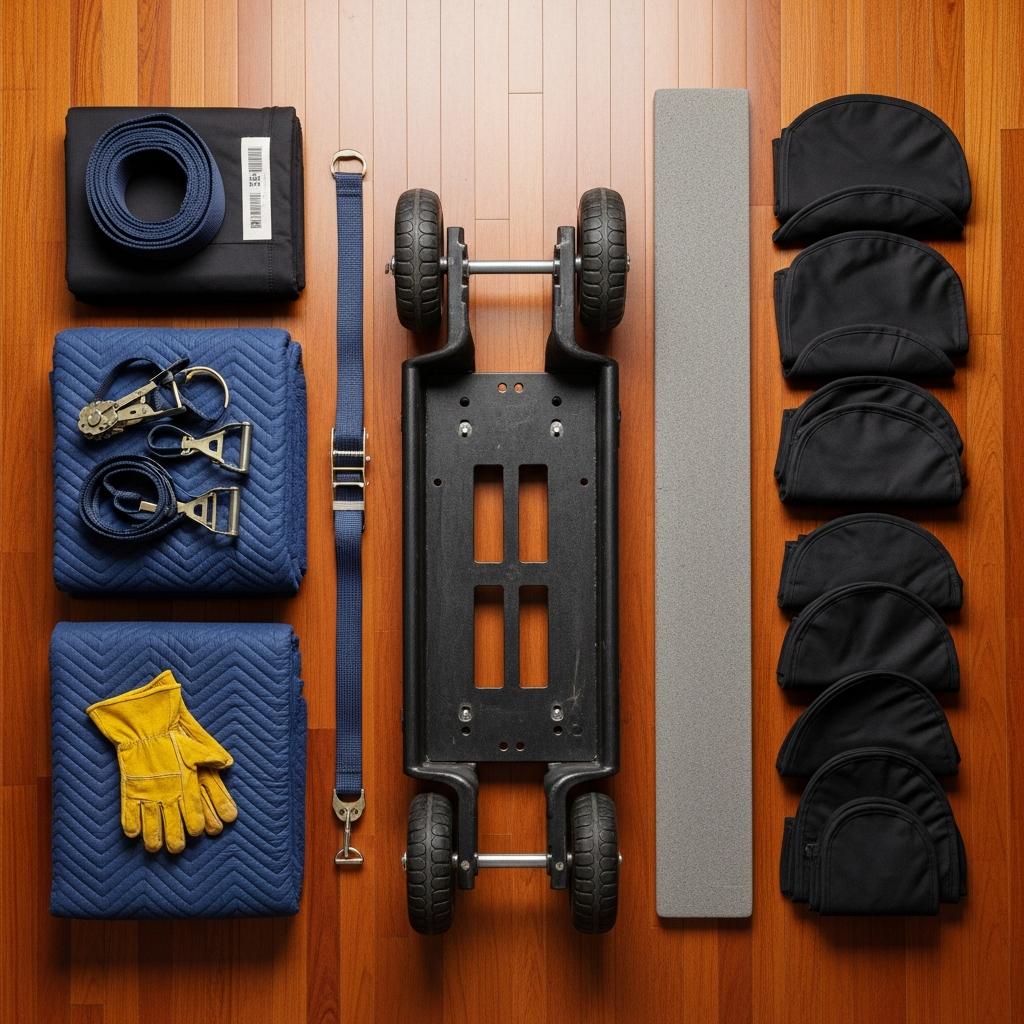
Phase 4: Transport Out of the Home
The crew moves slowly, with one person guiding from the front and at least one person controlling the back and sides. On stairs, a third or fourth crew member is essential to control descent — gravity is the enemy. Each step is announced. The piano is never carried by hand on stairs; it always remains on the board, with crew members controlling speed.
Phase 5: Loading the Truck
Pianos are loaded against an interior wall of the truck, never in the middle. Multiple ratchet straps anchor the piano-and-board assembly to e-track rails. Air-ride suspension trucks are strongly preferred for grand pianos and any move over 30 minutes — they reduce road vibration that can otherwise affect tuning and stress the soundboard.
Phase 6: Transport, Unload, and Setup
At the destination, the entire process runs in reverse. The piano is moved into position, legs are reattached one at a time while the instrument is supported, the lyre and music desk are reinstalled, and the piano is positioned in its final spot — typically on an interior wall, away from heat vents, exterior walls, and direct sunlight.
Equipment Real Piano Movers Use
You can identify a professional piano mover the moment they unload the truck. The right equipment is non-negotiable, and the difference between a $40 furniture dolly and a proper $600 piano dolly is the difference between a successful move and a destroyed instrument.
The Piano Board (Piano Skid)
A piano board is a custom-built, heavily padded wooden skid roughly 6 to 8 feet long, designed to support a grand piano laid on its side. The padding is typically dense felt over plywood. Multiple ratchet strap channels allow the piano to be securely fastened. No grand piano should ever be moved without one. If a moving company shows up without a piano board, send them home.
The Four-Wheel Piano Dolly
Heavy-duty piano dollies have four large rubber wheels (not casters) rated for 1,500+ lbs. They roll smoothly on hardwood, tile, carpet, and short transitions. Cheap furniture dollies with small swivel casters can collapse under a grand piano's weight or refuse to roll over thresholds.
Quilted Moving Blankets and Stretch Wrap
Heavy professional quilted blankets — not the thin grey blankets sold at hardware stores — wrap every piano. Each blanket is roughly 6'×6' and weighs 7+ lbs. Multiple blankets cover all sides of the piano, secured with rubber bands or industrial stretch wrap. The goal is full surface coverage with zero exposed wood.
Ratchet Straps and E-Track Anchors
Multiple ratchet straps secure the piano to the board, and additional straps anchor the assembly inside the truck via e-track rails on the truck walls. Cargo straps with cam buckles (the cheap kind) are not sufficient for a grand piano.
Stair Equipment
For multi-flight or curved staircases, professional crews use stair-climbing piano dollies with rubber tracks (Wesco-style) or piano cranes. These tools allow controlled descent without the entire weight of the piano being held by the crew on each step.
Tools for Disassembly
Allen keys, socket sets, soft-tip mallets, and replacement bolts for piano legs and lyres. Premium movers carry replacement hardware in case original bolts strip — a 100-year-old piano often has fragile threads that can shear during disassembly.
⚠️ Red Flag: If the moving crew arrives with only standard furniture dollies, regular cargo straps, and a few thin blankets — refuse the move. This is the equipment for a couch, not a $30,000 instrument. Reputable trusted piano relocation specialists arrive with dedicated piano gear or they don't take the job.
Insurance, Liability, and Protecting a Six-Figure Instrument
Pianos are among the highest-value items most homeowners ever own. A used Yamaha U1 upright is worth $4,000–$8,000. A new Steinway B is over $100,000. A Bösendorfer Imperial Grand exceeds $250,000. Standard moving insurance does not adequately protect instruments at these values.
Three Types of Coverage You Need to Understand
- Released-value protection: The default, included free. Pays $0.60 per pound. A 600-lb grand piano destroyed in transit pays $360. Useless for any piano of value.
- Full-value protection: The mover is liable for the actual cash value of damage. Better, but typically capped well below the replacement cost of premium pianos.
- Musical instrument rider / declared-value insurance: The piano is appraised, the value is declared on the contract, and damages are covered up to that declared amount. This is the only appropriate coverage for serious instruments.
What to Verify Before the Crew Arrives
- Request and read the company's commercial general liability and cargo insurance certificates. Coverage should be at minimum $2 million CGL and $100,000 cargo per vehicle.
- For pianos over $10,000 in value, request the named musical instrument rider in writing on your contract.
- Confirm WSIB coverage in Ontario — an injured crew member without WSIB can sue the homeowner directly.
- Ensure the mover is registered with the Canadian Association of Movers (CAM) and check Better Business Bureau records.
For a deeper dive into mover insurance and licensing requirements in Ontario, see our complete insurance and licensing guide for Ottawa movers.
Ottawa-Specific Challenges: Stairs, Winter, and Heritage Homes
Moving a piano in Ottawa is fundamentally different from moving one in a flat, warm climate. Three local realities shape every piano move in the National Capital Region.
Heritage Staircases in Centretown, The Glebe, and Sandy Hill
Many of Ottawa's most beautiful homes were built between 1880 and 1925 — long before pianos were a household norm. Their staircases are narrow, often L-shaped, with quarter-turn landings designed for human passage, not a 7-foot grand. Professional movers in these neighbourhoods routinely remove banisters, lift doors off their hinges, and occasionally remove window sashes to create a clear path. If you're moving in Centretown, The Glebe, or Westboro, expect a thorough site survey before booking.
Winter Moves: The Single Biggest Risk to Pianos
Ottawa winters are brutal on pianos. Sudden temperature changes cause the wooden soundboard, bridges, and pin block to contract rapidly. Moving a piano from a warm home into a -25°C truck and back into another warm home can crack the soundboard, loosen tuning pins, and warp the case. This is why professional Ottawa piano movers:
- Use heated, insulated trucks during winter months.
- Wrap pianos in waterproof exterior covers to block snow and salt spray.
- Recommend customers wait 24–48 hours after delivery before opening the lid or playing — letting the instrument acclimate to the new home's temperature and humidity.
- Schedule winter tunings 2–4 weeks after delivery, not immediately.
Condo and High-Rise Moves
Ottawa's downtown core, Westboro, and Lansdowne areas have hundreds of condo buildings, many with strict moving rules. A piano move in a condo requires:
- Booked freight elevator (typically 2–4 hours).
- Certificate of Insurance (COI) submitted to building management 2–7 days in advance.
- Verified elevator dimensions — many freight elevators cannot accommodate a 7-foot grand.
- Loading dock access permits in some buildings.
For a complete walkthrough of condo moving logistics, see our apartment and condo moving guide.
Key Takeaway: Ottawa's combination of heritage homes, harsh winters, and high-rise condo logistics makes it one of the most demanding piano-moving markets in Canada. This is exactly why generalist movers fail here — and why experienced movers in Ottawa with specific piano experience are essential.
How to Choose a Piano Moving Company in Ottawa
The Ottawa moving market has hundreds of companies — but only a handful are genuinely qualified to move a serious piano. Use this checklist when interviewing piano movers:
Verification Checklist
- Years of piano-specific experience: Ask how many piano moves the company completes per year, not just total moves. A company doing 50+ piano moves annually has the muscle memory; a company doing two or three is improvising.
- Equipment inventory: Ask whether they own (not rent) piano boards, four-wheel piano dollies, stair-climbing equipment, and air-ride trucks. Owned equipment signals commitment.
- Insurance documentation: Request CGL, cargo, and musical instrument rider certificates in writing.
- Crew minimum: Confirm a minimum of 3 movers for any grand piano move — 4 if stairs are involved. Two-person crews on a grand are a deal-breaker.
- References from piano teachers and tuners: Local Ottawa piano technicians know exactly which movers are reliable. Ask your tuner — they will tell you who to call and who to avoid.
- Written, binding quote: Phone estimates with vague "starting at" pricing usually balloon on moving day. Insist on a binding written quote.
- Reviews specific to piano moves: Read Google reviews, then search the reviews specifically for the word "piano." A company with 500 reviews and zero piano mentions is not a piano specialist.
Questions to Ask Every Quote Provider
- "What's your process for protecting hardwood floors and door jambs?"
- "What insurance covers my piano if it's damaged in transit, and what's the maximum payout?"
- "Will the same crew that quoted me show up, or are jobs subcontracted?"
- "How do you handle stairs — what's your equipment and crew approach?"
- "Do you use climate-controlled trucks in winter?"
- "What's your damage claim process and average resolution time?"
If a company hesitates on any of these questions, move on. The right answers should come quickly and confidently. Ottawa's specialty moving experts will walk you through every detail before you ever sign a contract.
Red Flags to Avoid
- No physical address: Piano movers operating only from a phone number with no listed Ottawa address.
- Cash-only pricing: Reputable movers accept credit cards and provide proper invoices.
- Pressure tactics: "Book today or the price doubles" is a scam playbook.
- No site survey for a grand piano: Any mover willing to quote a grand sight-unseen is gambling with your instrument.
- Sub-$200 grand piano quotes: Below-market pricing on grand pianos is impossible to deliver safely. The cost of insurance, equipment, and a 3-person crew on a 600-lb instrument cannot be done for $150.
Preparing Your Piano (and Your Home) for Moving Day
Most homeowners think there's nothing to do before the movers arrive — that's not true. Proper preparation makes the move faster, safer, and cheaper.
The Week Before
- Have the piano tuned 2 weeks before the move only if you want a baseline reference. Most experts recommend skipping pre-move tuning since the move will require post-move re-tuning anyway.
- Photograph the piano from all angles, including pedal lyre, music desk, and bench. These photos become evidence if a damage claim is required.
- Locate original keys for the lid lock and fallboard lock — if missing, the mover will tape these closed.
- Confirm the freight elevator booking and COI submission for condo moves.
- If moving in winter, ensure the destination home will be 18–22°C and 35–55% humidity by arrival day.
The Day Before
- Clear all sheet music, picture frames, and decor off the piano.
- Remove items from the piano bench storage compartment.
- Vacuum behind and under the piano — once it's gone, you may not see that floor again for years.
- Remove any items from hallways and stairs along the move route.
- Confirm the parking arrangement for the moving truck — Ottawa's residential streets often require advance permits. Visit the City of Ottawa moving permit page to confirm requirements for your street.
Moving Day Morning
- Be present and reachable. Decisions about routing, door removal, or floor protection require homeowner consent.
- Have a printed copy of the binding quote and insurance documents on hand.
- Photograph the piano one more time immediately before the crew touches it.
- Provide the crew with bottled water — Ottawa summers and winters are both physically punishing.
After the Move: Acclimation, Tuning, and First Play
Resist the urge to play the piano immediately after delivery. Pianos are precision instruments built around tightly tensioned strings, a wooden soundboard, and a cast-iron plate — they need time to settle into their new environment.
The Acclimation Period
Allow 2–4 weeks of acclimation before a post-move tuning. The wooden components — soundboard, bridges, pin block — need time to adjust to the new temperature and humidity. Tuning during this period is wasted money because the piano will drift again as it settles.
During acclimation:
- Keep the piano in its final position — don't move it again, even a few feet.
- Maintain consistent indoor humidity (35–55% is ideal). In Ottawa's dry winters, a humidifier near (not on) the piano helps significantly.
- Avoid placing the piano against an exterior wall, near a heat vent, fireplace, or in direct sunlight.
- You can play the piano during acclimation — just don't tune it yet.
Booking the Post-Move Tuning
Find a Registered Piano Technician (RPT) certified by the Piano Technicians Guild. Ottawa has roughly a dozen RPTs serving the National Capital Region. Tuning costs $150–$250 depending on the technician and the condition of the piano. If the piano hasn't been tuned in over a year, expect a "pitch raise" first ($50–$100 additional) followed by a fine tuning.
What to Watch For Post-Move
- Listen for any new buzzing, rattling, or sympathetic vibrations — these indicate a loose component that should be addressed before tuning.
- Check that all pedals respond correctly. The lyre may need adjustment after reinstallation.
- Inspect the case for any new scratches or dents — claims must typically be filed within 7–14 days of delivery, so don't delay.
- If the piano sounds significantly worse than before the move (beyond expected detuning), call your mover immediately.
Common Piano Moving Mistakes That Destroy Instruments
After years in the Ottawa moving market, the pattern of preventable disasters becomes painfully clear. These are the mistakes that turn a $30,000 piano into firewood:
Mistake #1: Letting General Movers Take "Just One Piano"
This is the most common and most expensive error. A standard moving crew without piano-specific training, dollies, or boards will damage the piano on stairs, scrape it on door jambs, or drop it during the lift onto its side. The cost of a real piano specialist is a fraction of a single damage claim.
Mistake #2: Skipping the Site Survey
Phone quotes are fine for an upright on a ground floor. They are dangerous for any grand piano. A 5-minute walkthrough catches the staircase that won't accommodate a 6-foot grand before the crew is mid-move trying to figure out a $1,500 hoisting solution.
Mistake #3: Moving in Extreme Weather Without Climate Control
Loading a piano into an unheated truck in February guarantees soundboard stress. A reputable Ottawa piano mover uses heated, insulated trucks year-round.
Mistake #4: Tuning Immediately After the Move
Tuning a piano that hasn't acclimated is throwing money away. The instrument will drift within days. Wait the recommended 2–4 weeks.
Mistake #5: Choosing Based on Lowest Quote
Three quotes for an upright move: $200, $350, $400. The $200 quote almost always means missing equipment, no insurance rider, or a sub-contracted crew. The premium of $150–$200 to hire a real specialist is the cheapest insurance you'll ever buy on a piano move.
Mistake #6: Leaving the Piano in a Bad Spot After Delivery
Placing the piano against an exterior wall, next to a heat vent, in front of a sunny window, or in a basement with seasonal humidity swings will damage it long after the movers have left. The right room and right placement matter as much as the move itself.
⚠️ Worst-Case Scenario: The most common total-loss claim in Ottawa piano moving involves a grand piano dropped on a residential staircase by an under-equipped crew. The piano falls, the cast iron plate cracks, and the damage exceeds the instrument's insured value. The homeowner's released-value coverage pays $400. The piano's actual replacement cost was $40,000. Don't be that homeowner — hire a specialist.
Frequently Asked Questions About Piano Movers in Ottawa
How much do piano movers in Ottawa cost in 2026?
Local piano moves in Ottawa typically cost $250–$450 for an upright on a single floor, $500–$1,200 for a baby grand, and $800–$2,500+ for full grand pianos. Stairs, distance, and after-hours scheduling all add to the base price. For long distance moves to Toronto or Montreal, expect $1,500–$3,500 for grand pianos.
How long does it take to move a piano?
A typical local upright piano move takes 1.5–3 hours from arrival to setup. Grand piano moves take 3–6 hours due to disassembly, transport, and reassembly. Stair work or condo elevator moves can extend this to a full day.
Do I need to tune my piano after a move?
Yes — almost always. Even a careful, professional move will detune a piano slightly because of vibration, temperature changes, and humidity differences between locations. Schedule a tuning 2–4 weeks after delivery to allow the piano to acclimate first. Cost: $150–$250 with a Registered Piano Technician.
Can piano movers handle stairs?
Yes — but only with the right equipment and crew. Professional Ottawa piano movers use stair-climbing piano dollies, piano boards, and 3–4 person crews specifically for stair work. Avoid any company quoting a stair piano move with a 2-person crew or without a board.
Can general movers move a piano?
Some can, but most should not. General residential moving crews lack the equipment (piano boards, four-wheel piano dollies, stair-climbing tools) and insurance riders specifically required for instruments. For any piano valued over $5,000, hire a piano specialist.
What size truck do piano movers use?
Most piano-only moves use a 16–20 ft box truck with air-ride suspension and an interior with e-track anchor rails. For combined household and piano moves, a 26 ft truck is standard. Climate-controlled (heated and insulated) trucks are essential for Ottawa's winter months.
Do I tip piano movers in Ottawa?
Tipping is appreciated but not required. Standard practice is $20–$50 per crew member for a straightforward upright move, $50–$100 per person for grand piano or stair-heavy moves. For a complete tipping breakdown, see our guide to tipping movers in Ottawa.
Can I move my piano with a U-Haul?
Technically yes, practically no. Renting a truck and recruiting friends to move a piano is the single highest-risk DIY moving decision possible. Without piano boards, dollies, training, and insurance, the chance of damaging the instrument or injuring someone is extremely high. Even a "small" upright weighs more than two refrigerators.
How far in advance should I book a piano mover in Ottawa?
Two to four weeks is ideal for non-peak moves. During the May–September peak, book 4–6 weeks in advance. Same-day and next-day piano moves are sometimes available but carry a 25–50% premium and limited mover selection.
What's the best company for piano moving in Ottawa?
Look for movers with documented piano-specific experience, owned (not rented) piano boards and dollies, musical instrument insurance riders, and consistent positive reviews specifically mentioning piano moves. Expert Ottawa piano movers will provide all of this documentation upfront.
Is climate-controlled storage necessary for pianos?
Yes — for any storage longer than 1–2 days, especially in Ottawa's seasonal extremes. Climate-controlled storage maintains 18–22°C and 35–55% humidity year-round, preventing soundboard cracking and tuning instability. Expect $80–$200/month for a piano-sized climate-controlled unit.
What if my piano is damaged during the move?
Document the damage immediately with photos, notify the moving company within 24 hours in writing, and request the claims process documentation. With proper musical instrument coverage, repairs or replacement up to the declared value are covered. Without it, you may be limited to released-value protection of $0.60 per pound.
Ready to Move Your Piano in Ottawa? Whether it's a beloved upright that's been in the family for generations or a concert grand worth more than a luxury car, the safe transport of your instrument depends entirely on hiring movers who specialize in pianos. Call (613) 600-4000 for a free, no-obligation piano moving quote, or visit our free quote page to get pricing in under 2 minutes. Our team has moved thousands of pianos across the National Capital Region — from spinets in Barrhaven bungalows to nine-foot Steinways in Rockcliffe Park.