Planning a Cross-Country Move With Pets
A long-distance move is stressful for everyone in the household, but our four-legged family members often feel it most acutely. Pets read our energy, lose access to familiar smells and routines, and frequently endure several days of unfamiliar travel before arriving in a brand-new home that smells of strangers. A cross-country relocation from, say, Ottawa to Calgary or Toronto to Vancouver covers thousands of kilometres and multiple days on the road, which makes early, deliberate planning the single biggest factor in keeping your animals calm and safe.
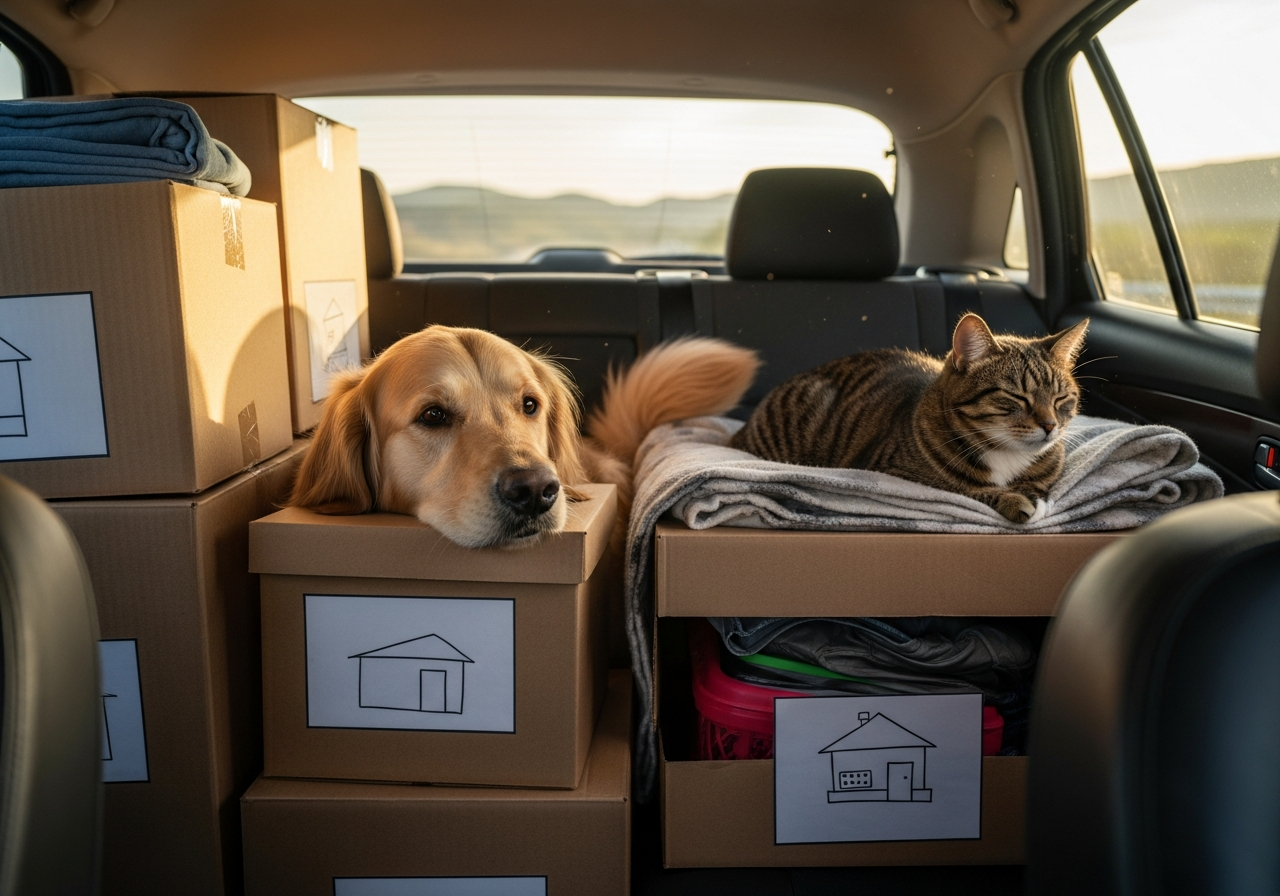
The first rule of moving with pets is to start six to eight weeks out. That window gives you time to schedule a veterinary check-up, gather health records, research pet rules at your destination, and decide whether your animal will travel by car or by air. It also lets you separate the logistics of your household goods from the logistics of your pet's journey. The two should never be tangled together — your movers handle furniture and boxes, while you handle the living, breathing members of the family.
Working with full-service long distance movers for the household portion of the move frees you to focus entirely on your pet's comfort on travel day. When professionals are loading the truck, you are not juggling a terrified cat and a sofa at the same time. If you are still mapping out the broader logistics, our ultimate cross-Canada moving checklist walks through every household task in sequence so nothing slips through the cracks while you concentrate on the animals.
Key Takeaway: Treat your pet's journey as a separate project from your furniture move. Start planning six to eight weeks ahead, and let professional movers handle the household so you can focus on your animals.
How Different Animals Handle Long-Distance Travel
Not all pets experience travel the same way, and your plan should reflect your specific animal's temperament and species.
Dogs
Most dogs travel reasonably well by car, especially if they already enjoy rides. The challenge over a multi-day cross-country trek is managing energy, bathroom breaks and overheating. Large dogs need a secured crate or a vehicle harness, and every dog needs frequent stops to stretch, hydrate and relieve themselves. Plan a break roughly every two to three hours.
Cats
Cats are creatures of territory and tend to find travel far more stressful than dogs. Most cats do best confined to a secure, well-ventilated carrier rather than roaming a vehicle. Many will refuse food and water during transit and may vocalize for hours. Patience, a covered carrier and a familiar-smelling blanket go a long way.
Small mammals, birds and reptiles
Rabbits, guinea pigs, hamsters, birds and reptiles are extremely sensitive to temperature swings and motion. They typically must travel in the climate-controlled cabin of your vehicle, never in a moving truck or cargo hold without specialist arrangements. Reptiles in particular need stable heat, which can be difficult to maintain over a long winter drive across the Prairies.
Fish
Fish are the hardest pets to relocate over long distances. For a cross-country move, many owners rehome aquarium fish or work with a specialist, since transporting water-filled tanks thousands of kilometres is impractical and risky.
Whatever the species, never place a pet in the back of a moving truck. Reputable cross-country movers will tell you the same thing: the cargo area is unregulated for temperature and ventilation and is strictly for inanimate belongings. Choosing the right travel method early — covered in the timing section of our guide to the best time of year to move across Canada — helps you avoid the temperature extremes that endanger sensitive animals.
Veterinary Prep and Health Documentation
About four weeks before you leave, book a wellness visit with your current veterinarian. This appointment serves several purposes at once.
- Health certificate: Ask for an up-to-date health certificate confirming your pet is fit to travel. Airlines require this, and it is wise to have even if you are driving.
- Vaccination records: Obtain a printed and digital copy of your pet's complete vaccination history, especially rabies. Boarding facilities, new vets and some apartment buildings will ask for it.
- Medication supply: Request enough of any prescription medication to cover the move plus a buffer until you find a new vet.
- Anxiety management: If your pet is a nervous traveller, discuss calming aids, pheromone products or, in extreme cases, mild sedation. Never medicate a pet for travel without veterinary guidance.
- Microchip check: Confirm the microchip is registered and the contact details are current — you will update them again once you have a new address.
Ask your vet for a referral or recommendation in your destination city, and request that your pet's full medical file be emailed to you so you can forward it to a new clinic. For general guidance on animal health and movement within Canada, the Canadian Food Inspection Agency is the federal authority worth consulting, particularly if you keep less common species. The federal government's health services portal can also help you locate provincial veterinary resources.
💡 Pro Tip: Photograph every page of your pet's records on your phone the day you receive them. If a paper file goes missing in the chaos of moving day, you will still have everything you need to register with a new vet.
Driving vs Flying With Your Pet
The single biggest decision in a cross-country pet move is whether your animal travels in your car or on a plane. Each route has real trade-offs.
Driving
Driving keeps your pet with you the entire time, lets you control stops, temperature and comfort, and avoids the trauma of cargo holds. The downside is duration: a Toronto-to-Vancouver drive is roughly 4,400 kilometres and 5 to 7 days, which is a long time for an anxious cat. Driving suits dogs and calm cats well, and it lets you transport food, crates and supplies without weight limits.
Flying
Flying is dramatically faster — a few hours instead of a week — which can be kinder for highly stressed animals if they tolerate carriers. However, it introduces airline crate requirements, temperature embargoes (airlines often refuse cargo-hold pets during extreme heat or cold), breed restrictions for snub-nosed dogs and cats, and added cost. Small pets that fit under a seat in an approved carrier can fly in the cabin, which is far less stressful than the hold.
Decision factors:
- Pet size and whether it can fly in-cabin
- Your pet's anxiety level and travel history
- Season — winter Prairie drives and summer heat embargoes both pose risks
- Total distance and number of travel days
- Budget for flights, pet fees and accommodation
If you drive, your household goods can travel separately on the moving truck and meet you at the other end, which is exactly how experienced long distance moving services coordinate timing for families on the road. That separation means you are never waiting in an empty house with stressed pets and no furniture — schedule delivery for a day or two after you arrive so you can pet-proof first. Families moving with both kids and animals will also want to read our companion guide on moving across Canada with kids and family, since the logistics overlap heavily.
Provincial Rules and Regulations for Pets
Canada has no internal border controls for common household pets, so you will not face quarantine moving from one province to another. That said, several provincial and municipal rules matter once you arrive.
- Licensing: Most municipalities require dogs (and sometimes cats) to be licensed locally. You will need to register in your new city within a set window, often 14 to 30 days.
- Breed legislation: Some provinces and cities have breed-specific legislation. Ontario, for example, has historically restricted certain breeds. Research your destination city's bylaws before you move so you are not caught off guard.
- Leash and licensing bylaws: Off-leash rules, the number of pets allowed per household and exotic-animal permits vary widely by municipality.
- Rabies and vaccination: Rabies vaccination is effectively required nationwide; keep proof accessible.
If you keep exotic species, reptiles or birds, check both provincial wildlife regulations and the CFIA for any movement restrictions. The Canadian Association of Movers can also point you to vetted relocation professionals who understand the cross-province logistics of travelling with animals.
⚠️ Check breed bylaws early: Breed-specific legislation can affect housing, insurance and even whether you can legally keep your dog in a given municipality. Confirm the rules in your destination city before you sign a lease or finalize the move.
Packing a Pet Travel Kit
Pack a dedicated pet kit that travels in your vehicle's cabin — never in a sealed box bound for the truck. This kit should be the last thing you load and the first thing you unpack.

Essentials to include
- Food for the entire trip plus three extra days, in a sealed container
- Collapsible or spill-resistant food and water bowls
- Bottled water from home (sudden water changes can upset stomachs)
- Medications, supplements and a copy of the health records
- Leash, harness and a backup leash
- Waste bags, a litter box and litter for cats
- A familiar blanket, bed or toy that smells like home
- Towels, paper towels and pet-safe cleaning wipes for accidents
- A recent photo of your pet in case it goes missing
- A pet first-aid kit
Keep this kit organized in one clearly labelled bag so it is easy to grab at each rest stop and hotel. While professional professional long distance movers carefully box and protect everything else you own, the pet kit is the one bag that stays under your direct control from start to finish. For ideas on packing the rest of the household efficiently, our cross-Canada moving checklist covers room-by-room preparation that keeps moving day calm for both you and your animals.
💡 Pro Tip: Don't switch your pet's food or water brand during the move. Keep everything identical to reduce the chance of digestive upset on the road, then transition slowly once you are settled.
Keeping Pets Calm on Moving Day
Moving day is chaotic — doors propped open, strangers carrying boxes, furniture disappearing. For a pet, it can be genuinely frightening, and an open door is an escape risk. The safest strategy is to remove your pet from the action entirely.
Best options for moving day
- Daycare or boarding: Book your dog into daycare or your cat into a quiet boarding room for the loading day.
- A friend's home: A trusted friend or family member can keep your pet away from the noise.
- A closed, empty room: If neither is possible, confine your pet to one empty bathroom or bedroom with food, water and a litter box. Tape a clear sign on the door reading "DO NOT OPEN — PET INSIDE" so the moving crew never enters.
Maintain your pet's normal feeding and walking routine as much as possible on moving day. Animals draw comfort from predictability, and a familiar schedule signals that, despite the upheaval, they are still cared for. Reputable interprovincial moving company crews are used to homes with pets and will respect a closed-door sign, but it is your job to make the boundary obvious and to keep the animal physically secure.
⚠️ Escape risk: The most common moving-day accident with pets is a dash through a propped-open front door. A confined room with a clear warning sign, or off-site care, eliminates this risk entirely.
On the Road: Multi-Day Travel Tips
A cross-country drive with pets is a marathon, not a sprint. Build the itinerary around your animal's needs rather than maximum daily distance.

Safe travel practices
- Secure every pet: Use a crash-tested crate or a vehicle safety harness. An unrestrained pet is dangerous in a collision and a distraction for the driver.
- Never leave a pet in a parked car: Interior temperatures climb dangerously fast in summer and plunge in winter. If you must stop, one person stays with the animals.
- Frequent breaks: Stop every two to three hours for water, a walk and a bathroom break for dogs.
- Feed lightly: A large meal before driving can cause motion sickness. Offer small portions and feed the main meal at the end of the day's drive.
- Book pet-friendly hotels: Confirm pet policies in advance; many chains welcome animals but charge a fee, and rooms fill quickly along the Trans-Canada corridor.
Plan your daily distances conservatively. Where a solo driver might cover 800 kilometres, a day with a stressed cat may be more comfortable at 500 to 600. The timing of your trip matters too: winter drives across the Prairies and mountain passes add ice, closures and bitter cold, while summer brings heat risk — both are explored in our best time of year to move across Canada guide. Coordinating your arrival with delivery scheduled through your long distance moving company means you can settle the pets first and let the furniture follow.
Settling Pets Into Your New Home
Arriving is only half the battle. Pets need time and structure to accept a new territory as home.
The one-room method
Before you let your pet explore the whole house, set up a single "safe room" — ideally before the furniture arrives. Place familiar items there: the same bed, blanket, bowls, litter box and toys your pet used in your old home. Let the animal acclimatize to one room first, then gradually open up the rest of the house over several days.
Re-establish routine fast
Feed, walk and play at the same times you did before the move. Routine is the fastest way to communicate safety. Keep cats indoors for at least two to three weeks before any supervised outdoor access, since disoriented cats can bolt and become lost in an unfamiliar neighbourhood.
Pet-proof the new space
Check fences for gaps, secure window screens, identify hiding spots, and remove any hazards the previous occupants left behind. Locate the nearest 24-hour emergency vet on day one so you are never scrambling in a crisis.
Because reputable nationwide moving company crews can stage delivery a day or two after you arrive, you have a window to pet-proof and set up the safe room before boxes start flowing in. If children are also adjusting to the new home, the settling strategies in our guide to moving across Canada with kids pair well with the pet routine above — a calm child usually means a calmer pet.
Key Takeaway: Use the one-room method, restore daily routines immediately, and keep cats indoors for two to three weeks. Familiar smells and predictable schedules turn a strange house into home faster than anything else.
Updating Records, Licences and Tags
Once you are settled, work through the administrative side of pet ownership in your new province.
- Microchip registration: Update your contact details and new address with the microchip registry immediately.
- ID tags: Order new tags engraved with your current phone number and address.
- Municipal licence: Register your dog (and cat where required) with your new city within its deadline.
- New veterinarian: Book an introductory appointment, transfer the medical file you collected, and refill any medications.
- Pet insurance: Notify your insurer of the new address, as premiums can vary by region.
Updating your pet's records sits alongside the broader address-change tasks every cross-country mover faces. The same week you handle the microchip and licence, you should also be updating your own records — our detailed moving checklist sequences all of it. For the human side of provincial paperwork, government resources like the federal Government of Canada services portal point you to provincial licensing offices. When you are ready to lock in your household move, you can request a free moving quote and coordinate truck timing around your pet's arrival.
Costs and Budgeting for Moving With Pets
Moving with pets adds line items most people overlook. Budget for them up front so there are no surprises.
Typical 2026 pet-moving costs (CAD):
- Pre-move vet visit and health certificate: $80 – $250
- Airline pet fee (in-cabin): $50 – $150 per flight
- Airline pet fee (cargo hold): $200 – $600+ depending on size and route
- Airline-approved crate: $60 – $300
- Pet-friendly hotel surcharges: $25 – $75 per night
- Boarding or daycare on moving day: $30 – $70 per day
- New municipal licence: $15 – $80
- Professional pet relocation service (full): $1,000 – $3,500+ for door-to-door air transport
For most families driving across Canada, the pet portion of the budget is modest — a few hundred dollars in vet fees, hotel surcharges and supplies. Flying, especially for large dogs in the cargo hold, climbs quickly and may justify a professional pet relocation specialist. Keep these costs separate from your household moving estimate so you can compare quotes from long distance moving services accurately. To understand how the household side of your budget is built, our guide on timing your move explains how season affects overall pricing — and moving in shoulder season often lowers both your truck cost and your pet-travel risk at the same time.
💡 Pro Tip: Booking your household move in spring or fall avoids both summer airline heat embargoes and treacherous winter highway conditions — protecting your wallet and your pet in one decision.
Frequently Asked Questions
Can my pet travel in the moving truck?
No. The cargo area of a moving truck is not temperature-controlled or ventilated for living animals and is extremely dangerous. Pets must travel with you in your vehicle's cabin or by air in an approved carrier. Professional movers will never transport a live animal in the truck.
Should I drive or fly my pet across Canada?
It depends on your pet's size, temperament and the season. Driving keeps your pet with you and avoids cargo-hold stress but takes several days. Flying is faster but introduces crate requirements, breed restrictions and seasonal temperature embargoes. Calm dogs and cats often do well by car; highly anxious small pets that fit in-cabin may do better on a short flight.
Do I need any documents to move my pet between provinces?
There is no quarantine for common pets moving within Canada, but you should carry up-to-date vaccination records and a health certificate. Airlines require a health certificate, and you will need vaccination proof to license your pet and register with a new vet. Check the CFIA for any rules affecting exotic species.
How do I keep my cat calm during a long drive?
Keep your cat in a secure, covered carrier with a familiar-smelling blanket, maintain a quiet environment, and avoid opening the carrier except in a fully enclosed space. Many cats refuse food and water on the road; offer it at hotel stops. Ask your vet about pheromone sprays or, in severe cases, anti-anxiety options.
When should I update my pet's microchip and tags?
Update your microchip registration and order new ID tags as soon as you have your new address confirmed. This is one of the most important post-move tasks — if your disoriented pet escapes in a new neighbourhood, current contact information is what reunites you.
How long until my pet adjusts to the new home?
Most pets settle within two to four weeks with consistent routines and a gradual room-by-room introduction. Keep cats indoors for at least two to three weeks before any outdoor access. Restoring familiar feeding, walking and play schedules speeds adjustment dramatically.
What should be in my pet's travel kit?
Pack food for the trip plus three extra days, water from home, bowls, medications, health records, a leash and backup, waste bags or litter, a familiar blanket, a first-aid kit and a recent photo. Keep this kit in your vehicle cabin, never on the moving truck.