Why Vancouver Is Canada's Top Long-Distance Destination
Vancouver has been one of the fastest-growing destinations for interprovincial migration in Canada for the better part of a decade. According to the 2026 Statistics Canada interprovincial migration report, more than 62,000 Canadians moved to British Columbia from other provinces last year, with the overwhelming majority landing in Metro Vancouver, Victoria and the Okanagan.
The reasons are familiar: mild coastal climate, world-class outdoor recreation, a diversified tech and film economy, and proximity to the Pacific Rim. But the logistics of actually getting a household from Toronto, Calgary, Ottawa or Halifax to Vancouver are anything but simple. Cross-country moves involve mountain passes, weight-and-distance pricing, multi-day transit, insurance complexities and a level of coordination that local moves never require.
That is why working with experienced long distance movers in Vancouver who specialize in interprovincial relocations — rather than a local Toronto or Calgary crew that happens to take long-haul jobs occasionally — is one of the most important decisions you will make.

Quick stat: Vancouver is the destination for roughly 23% of all interprovincial long-distance moves in Canada — second only to the GTA. Average shipment travels between 3,400 and 4,600 kilometres.
How Long-Distance Moving to Vancouver Works
A long-distance move to Vancouver is fundamentally different from a local move. Instead of a single hourly-billed day with one crew, you are coordinating a multi-day logistics operation that may involve different crews at pickup and delivery, weight-based pricing, multi-day truck transit, and storage windows.
A typical full-service interprovincial move to Vancouver includes:
- Pre-move survey and binding estimate: A consultant assesses your home in person or via video walk-through and provides a guaranteed price based on weight and distance.
- Packing services (optional but recommended): Cross-country transport puts more stress on belongings than a local move, so professional packing is widely recommended for fragile items.
- Loading at origin: Your shipment is loaded onto a dedicated truck or consolidated trailer.
- GPS-tracked transport: Most reputable carriers provide tracking so you can monitor the shipment's progress across the country.
- Delivery window: Long-distance shipments typically have a 3–10 business day delivery window depending on origin city.
- Unloading and reassembly: Crew at the Vancouver destination unloads, places furniture, reassembles, and removes packing materials.
- Storage-in-transit: Climate-controlled warehouse storage in Vancouver while you wait for possession of your new home.
Experienced movers in Vancouver who handle interprovincial relocations have established partner networks across the country, dedicated long-haul trucks, and warehouse facilities for storage-in-transit. This infrastructure is what separates real cross-country specialists from local movers who occasionally take a long-haul booking.
Toronto to Vancouver: Route, Cost & Timeline
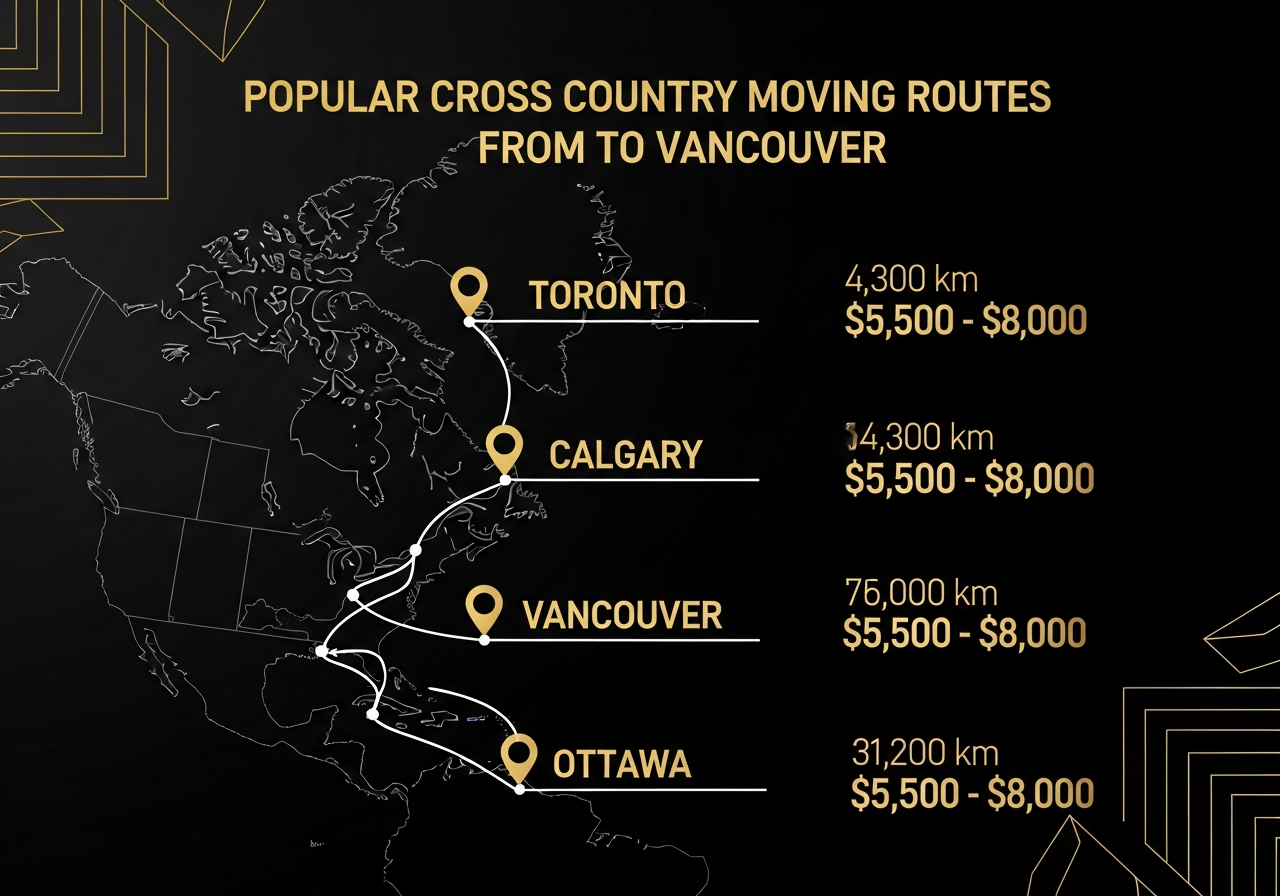
Toronto to Vancouver is the longest and most heavily travelled interprovincial moving corridor in Canada. The distance is approximately 4,400 kilometres via the Trans-Canada Highway and takes a moving truck 5–7 days door to door.
Average Toronto-to-Vancouver Moving Costs (2026):
- 1-bedroom apartment: $4,500 – $7,500
- 2-bedroom condo: $6,000 – $10,500
- 3-bedroom house: $8,500 – $14,000
- 4+ bedroom home: $12,000 – $22,000+
These ranges include loading, transport, fuel surcharges, and unloading. Add roughly 15–25% if you require full packing services, custom crating, or specialty handling for pianos, fine art or hot tubs.
Route Logistics
The standard route runs Toronto → Sudbury → Thunder Bay → Winnipeg → Regina → Calgary → Vancouver, crossing six provinces and four mountain passes (Kicking Horse, Rogers, Eagle, and Coquihalla). Winter conditions on the BC stretch (December through March) can add 1–2 days to delivery and occasionally require chains or temporary route diversions through the United States.
What Sets Toronto-Vancouver Routes Apart
- Weight matters more than volume: Pricing is almost always based on total shipment weight (in pounds) multiplied by distance.
- Delivery windows are wider: Plan for a 5–10 business day delivery window rather than a fixed date.
- Driver scheduling: Canadian hours-of-service rules limit drivers to 13 hours of driving per day, which is why even the fastest routes take a minimum of 5 days.
Calgary to Vancouver: What to Expect on the Mountain Route
The Calgary-to-Vancouver corridor is the most popular short-haul interprovincial route in Western Canada. At roughly 970 kilometres via the Trans-Canada Highway (Highway 1) through the Canadian Rockies, the trip takes a moving truck 1.5–2.5 days door to door.
Average Calgary-to-Vancouver Moving Costs (2026):
- 1-bedroom apartment: $2,200 – $3,800
- 2-bedroom condo: $3,200 – $5,500
- 3-bedroom house: $4,500 – $8,000
- 4+ bedroom home: $6,500 – $12,000+
The Mountain Route Reality
The Calgary-to-Vancouver drive crosses four major mountain passes — Kicking Horse, Rogers, Eagle and Coquihalla. In summer the route is straightforward; in winter it becomes one of the most challenging trucking corridors in North America. Reputable long distance movers in Vancouver that run this corridor regularly carry chains, use experienced mountain-rated drivers, and time departures around weather windows monitored through DriveBC.ca.
Best Time of Year for the Calgary Route
April through October offers the smoothest mountain conditions. November through March typically adds 1–2 days of transit time and a 5–10% weather surcharge from most carriers. The Coquihalla in particular is prone to closures after the 2021 atmospheric river damage — although repairs are complete, sudden closures still happen 3–6 times per winter.
Ottawa & Montreal to Vancouver: The 4,500 km Journey
Moves from Eastern Canada to Vancouver are the longest interprovincial relocations in the country. Ottawa to Vancouver is approximately 4,500 kilometres; Montreal to Vancouver is approximately 4,650 kilometres. Transit times typically run 6–10 business days.
Average Ottawa/Montreal-to-Vancouver Moving Costs (2026):
- 1-bedroom apartment: $5,000 – $8,500
- 2-bedroom condo: $6,800 – $11,500
- 3-bedroom house: $9,500 – $16,000
- 4+ bedroom home: $13,500 – $25,000+
The Eastern Canada–Vancouver corridor is dominated by consolidated long-haul carriers. Your shipment typically rides on a 53-foot trailer alongside one or two other households travelling the same general route, which keeps costs reasonable compared to a dedicated truck. Dedicated trucks are available — typically 30–40% more expensive — and worth considering for high-value or time-sensitive shipments.
Cross-Province Administrative Tasks
- Apply for MSP coverage immediately upon arrival in BC; there is no longer a waiting period as of 2020.
- Exchange driver's licence at ICBC within 90 days of establishing BC residency.
- Register vehicles with ICBC and obtain BC plates within 30 days.
- Update CRA address through My CRA Account.
- School transfers: BC public schools generally accept enrolment year-round; private and independent schools may have waitlists.
Cross-Country Pricing Models Explained
Long-distance moves to Vancouver are priced very differently from local moves. Understanding the pricing model your chosen mover uses is essential before signing any contract.
The Weight-and-Distance Formula
The dominant pricing model for interprovincial moves is weight-and-distance. Your shipment is weighed (either at a certified weigh station or via the mover's calibrated truck scales) and the cost is calculated as:
(Total weight in lbs ÷ 100) × distance-based rate per hundredweight (cwt) = base cost
A typical Toronto-to-Vancouver rate is $45–$75 per hundredweight, while a Calgary-to-Vancouver rate runs $22–$38 per hundredweight. A three-bedroom home typically weighs 7,000–10,000 lbs.
Volume-Based Pricing (Cubic Foot)
Some carriers price by cubic foot instead of weight, especially for shared loads. This is more common for smaller shipments (studios and 1-bedrooms) and partial loads being consolidated with other households.
Flat-Rate Binding Quotes
The gold-standard pricing model for long-distance moves. A binding quote guarantees the price you pay regardless of actual weight or volume on the truck — provided your inventory matches what was estimated. Always insist on binding quotes for moves over 1,000 km. A reputable Vancouver moving company that handles interprovincial relocations will always offer this option.
Additional Charges to Expect
- Fuel surcharge: 8–18% of base rate, adjusted with diesel prices
- Mountain pass surcharge: $200–$500 for BC interior routes in winter
- Long carry / stair charges: Same as local moves
- Shuttle service: $400–$800 if 53-foot trailers cannot access your Vancouver destination
- Storage-in-transit: $100–$300 per 30 days for typical household
Choosing the Right Long-Distance Vancouver Mover
Choosing a long-distance mover is significantly higher-stakes than choosing a local crew. The wrong choice can result in damaged belongings, missed delivery windows, "hostage situations" where additional cash is demanded at delivery, or in worst cases, total loss of your shipment. Use these criteria to filter ruthlessly:
- Interprovincial operating authority. Federal regulations require all interprovincial carriers to hold operating authority. Verify with the carrier directly and cross-reference through provincial transportation ministries.
- Membership in the Canadian Association of Movers. The CAM requires members to follow a strict code of ethics and provides a complaint resolution process.
- In-home or video survey, not a phone quote. Any long-distance estimate provided without seeing your home is a guess — and the guess will be wrong at delivery.
- Binding written estimate. Insist on a binding (not non-binding) quote that locks in the price.
- Real Vancouver warehouse and crew. Established residential movers in Vancouver have their own destination crews and warehouse facilities — not subcontracted day labour hired off Craigslist.
- Comprehensive cargo insurance. Confirm policy limits in writing and request a copy of the certificate.
- Verified reviews on multiple platforms. Look for consistent feedback across Google, BBB, the CAM directory, and Reddit.
⚠️ Red flag: Any long-distance mover that asks for more than 20% deposit upfront, or demands cash on delivery, should be considered high-risk. Legitimate professional movers in Vancouver accept credit cards and structure payment with clear milestones.
Packing for a Coast-to-Coast Move
Packing for a cross-country move is fundamentally more demanding than packing for a local one. Your belongings will spend 5–10 days on the highway, enduring road vibrations, temperature swings (from Prairie cold to BC coastal humidity), and multiple handling points as the truck is loaded, unloaded at consolidation depots, and reloaded.

Professional Packing Standards for Long-Distance
- Double-boxing for fragile items. Glassware, china, electronics and collectibles should be individually wrapped, placed in a smaller box, then nested in a larger box with cushioning.
- Custom crating. Artwork, mirrors, marble, glass tabletops and oversized fragile items should be custom-crated in plywood frames.
- Climate considerations. Wine collections, musical instruments, vinyl records and electronics may need climate-controlled transport.
- Sealed mattress and upholstery bags. Essential for moisture protection on the BC coastal stretch.
- Master inventory with high-resolution photos. Every box numbered, every item documented before loading. This is your proof for any insurance claim.
⚠️ What NOT to ship cross-country: Hazardous materials (paint, propane, cleaning chemicals), perishable food, medications, important documents (passports, birth certificates, financial records), jewelry, firearms, and irreplaceable items. These must travel with you personally.
Insurance, Valuation and Cross-Province Regulations
Insurance is one of the most misunderstood — and most consequential — aspects of long-distance moving. Default coverage is essentially worthless; understanding your real protection options can save you tens of thousands of dollars.
Coverage Levels Explained
Released Value Protection (default, free): $0.60 per pound per article. A 40-lb flatscreen TV worth $2,000 is covered for $24. Effectively useless for valuables.
Full-Value Protection (premium, paid): The mover is required to repair, replace, or reimburse the current market value of any damaged or lost item. Cost is typically 1–3% of declared shipment value. For a $75,000 household shipment, expect $750–$2,250.
Additional Protection Worth Considering
- Third-party moving insurance: Companies like MovingInsurance.com and Relocation Insurance Group sell standalone policies that often provide broader coverage than mover-issued plans.
- Homeowner / tenant insurance: Many policies extend coverage to goods in transit. Confirm with your insurer in writing.
- Auto transport insurance: If shipping a vehicle, verify the auto transport carrier's separate cargo policy.
Cross-Province Consumer Protection
British Columbia, Ontario, Quebec and Alberta each have separate consumer protection laws governing moving services. Cross-province moves can fall under the jurisdiction of either origin or destination province depending on contract terms. Always verify which jurisdiction governs your contract and how disputes are resolved. The Better Business Bureau provides cross-border complaint resolution that supplements provincial mechanisms.
Storage-in-Transit and Closing-Date Gaps
Long-distance moves rarely go directly from origin to destination on the same day. Closing dates do not align, new construction gets delayed, and you may need temporary housing while you settle into Vancouver. Storage-in-transit (SIT) is how reputable movers bridge these gaps.
How SIT Works in Vancouver
Your shipment is offloaded at the mover's Vancouver warehouse and held in secure, climate-controlled storage until you are ready for delivery. Most long-distance carriers include 30 days of SIT in their base price and charge $100–$300 per 30 days thereafter for a typical household.
What to Look For in a Vancouver Storage Facility
- Climate control. Essential for the BC coastal climate — humidity can damage wood furniture, electronics and artwork.
- Vaulted storage. Your goods are loaded into individual locked vaults rather than left on the truck or warehouse floor.
- 24/7 surveillance and access control. Cameras, alarm systems, and staffed access.
- Insurance continuity. Verify that your moving cargo insurance covers the storage period or arrange separate storage insurance.
Most established long distance movers in Vancouver operate their own warehouse facilities, which is preferable to subcontracted third-party storage where chain-of-custody and insurance can become murky.
Common Long-Distance Mistakes to Avoid
After coordinating thousands of cross-country moves into Vancouver, certain mistakes appear over and over again. Avoiding them is the difference between a smooth move and a disaster:
- Booking too late. Long-distance moves to Vancouver require 6–10 weeks of lead time during peak season. Last-minute bookings cost 30–50% more and limit your choice of carriers.
- Choosing solely on price. The cheapest cross-country quote is almost always either a guess (followed by surprise charges at delivery) or a hostage scam in waiting.
- Not decluttering ruthlessly. Every 1,000 lbs you eliminate saves $450–$750 on a coast-to-coast move. Sell, donate or discard aggressively before the truck arrives.
- Ignoring the binding/non-binding distinction. Non-binding estimates are not protective. Always require "binding" in writing.
- No condition documentation. Photograph every piece of furniture, every electronics serial number, and every wall and floor before loading. This documentation is your only leverage in a damage claim.
- Underestimating delivery windows. Plan for the wide end of the delivery window, not the narrow end. Have essentials, air mattress, and a few days of clothing in your personal vehicle.
- Forgetting to update addresses. CRA, MSP, ICBC, banks, employer, insurance, subscriptions — start updating two weeks before your move and continue for a month after.
- Packing prohibited items. Hazardous materials and propane will be removed and dumped (often without warning) and may delay your shipment.
Frequently Asked Questions
How long does a long-distance move to Vancouver take?
Calgary to Vancouver: 1.5–2.5 days. Edmonton to Vancouver: 2–3 days. Winnipeg to Vancouver: 3–4 days. Toronto to Vancouver: 5–7 days. Montreal/Ottawa to Vancouver: 6–10 days. Add 1–2 days for winter conditions on BC mountain passes.
What is the cheapest way to move to Vancouver from across Canada?
Consolidated long-haul carriers (shared trucks) typically cost 30–50% less than dedicated trucks. Move in the off-peak season (November–March) for an additional 15–25% discount. Decluttering aggressively before the move is the single biggest cost reduction — every 1,000 lbs eliminated saves $450–$750 on a coast-to-coast move.
Should I drive my car or ship it with my move to Vancouver?
For drives over 3,000 km (Toronto, Montreal, Ottawa) most people ship their vehicle via dedicated auto transport for $1,200–$2,200 and fly to Vancouver. For shorter drives (Calgary, Edmonton, Winnipeg), driving is often cheaper and lets you transport essentials. Many residential movers in Vancouver can coordinate auto transport through partner carriers.
Are long-distance moves to Vancouver insured?
By default only at $0.60 per pound per article (released-value protection), which is effectively worthless for valuables. Always purchase full-value replacement protection (1–3% of declared shipment value) for any shipment containing electronics, art or quality furniture.
How far in advance should I book interprovincial movers to Vancouver?
For peak season (May–September): book 8–12 weeks in advance. For off-peak (November–March): book 4–6 weeks in advance. Last-minute bookings (under 2 weeks) are possible but cost 30–50% more and limit your choice of reputable carriers.
What happens if my belongings are damaged en route to Vancouver?
Document the damage immediately at delivery by noting it on the bill of lading before signing. Photograph every damaged item. File a written claim within the timeframe specified in your contract (typically 9 months for interprovincial moves under federal regulations). If you purchased full-value protection, the carrier must repair, replace, or reimburse current market value.
Can long-distance Vancouver movers store my belongings during a closing gap?
Yes. Most established movers in Vancouver operate climate-controlled warehouses with vaulted storage. Typically 30 days are included in the base price, with $100–$300 per 30 days thereafter for a typical household. Verify insurance continuity during storage.
Do I need to be present at both pickup and delivery?
You or a designated representative must be present at both ends. The representative must have authority to sign the bill of lading, approve any changes, and authorize payment. A spouse, adult family member, or property manager can act as your representative.
For a free binding quote from a fully insured Vancouver moving company that specializes in interprovincial relocations from Toronto, Calgary, Ottawa, Montreal and beyond, book your in-home or video survey at least 6 weeks before your target moving date.